
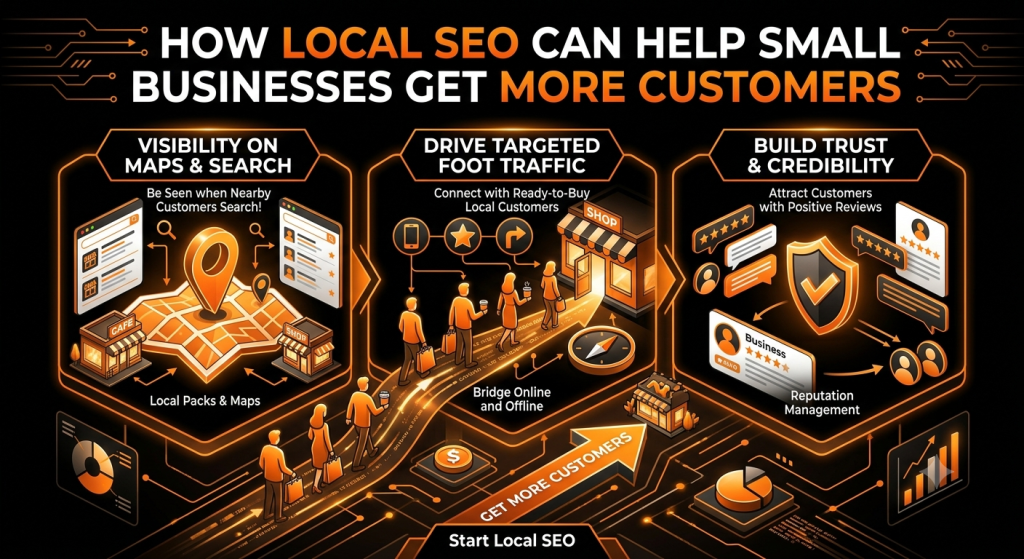
How Local SEO Can Help Small Businesses Get More Customers ?
How Local SEO Can Help Small Businesses Get More Customers Someone searches “plumber near me” or “best salon in Lucknow” on their phone. Google shows a handful of businesses with a map, star ratings, and a “Call now” button. If your business isn’t one of those results, that customer never finds you — they call whoever pops up first. This happens hundreds of times a day in every city, for every kind of business: clinics, salons, restaurants, repair shops, agencies, and home services. The businesses that show up get the calls, the walk-ins, and the bookings. The ones that don’t show up lose customers they never even knew they had a chance to win. That’s the entire idea behind Local SEO. It isn’t a technical trick or a one-time setup — it’s the ongoing work of making sure Google, and the people using it, can find your business, trust it, and choose it over the competition. In this guide, you’ll learn what Local SEO actually is, how it turns local searches into paying customers, and the practical steps you can start using this week — from your Google Business Profile to reviews, local keywords, citations, and mobile-friendly pages. What Is Local SEO? Local SEO is the practice of improving your business’s visibility in search results for people searching in or near your location. Instead of trying to rank for broad national terms, Local SEO focuses on searches tied to a place — a city, a neighborhood, or “near me.” Traditional SEO tries to get a website to rank for a topic, anywhere in the world. Local SEO tries to get a business to rank for that topic in a specific area, and to show up in Google’s local map results — often called the Local Pack — alongside the regular listings. A practical example: a bakery in Lucknow doesn’t need to rank for “cakes” across India. It needs to show up when someone nearby searches “cake shop near me” or “birthday cake delivery Lucknow.” That’s a Local SEO goal. Why Local SEO Matters for Small Businesses For a small business, visibility in local search isn’t a nice-to-have — it’s often the main way new customers discover you at all. A stronger local presence can lead to: More visibility in Google Maps and the Local Pack, right where buying decisions get made More website visits from people actively looking for what you sell More phone calls from ready-to-book customers More direction requests from people heading to your location More enquiries through your website or Google profile More walk-ins and store visits from nearby customers Increased trust, since a complete, well-reviewed profile signals a real, credible business Access to high-intent customers searching with the intent to buy, not just browse Unlike a billboard or a one-time ad, this visibility keeps working in the background every day, for every relevant search. How Local SEO Helps Small Businesses Get More Customers It helps to think of Local SEO as a journey, not a single action. A customer typically moves through several stages before becoming an actual customer: Local Search → Business Visibility → Website / Google Profile → Trust → Contact → Customer Local Search: Someone searches with local intent — “electrician near me” or “yoga classes in [city].” Business Visibility: Google decides which businesses are relevant enough to show, based on your profile, website, and reputation. Website / Google Profile: The searcher lands on your profile or website and forms a first impression. Trust: Reviews, photos, accurate information, and a professional-looking page build (or break) confidence. Contact: The customer calls, messages, requests directions, or fills out a form. Customer: The enquiry turns into an actual booking, sale, or visit. Local SEO touches every one of these stages. Skip one — say, your Google profile has no photos, or your reviews go unanswered — and customers drop out before they ever contact you. 1. Get Found When Customers Search Locally Location-based searches are some of the highest-intent searches on the internet. When someone types “dentist near me,” “digital marketing agency in Lucknow,” “best salon in [city],” “plumber near me,” or “restaurant near me,” they’re rarely just browsing — they usually want to book, call, or visit soon. That’s what makes these searches so valuable for small businesses. You’re not trying to convince someone they need a service; they’ve already decided. You just need to be one of the businesses they find, trust, and choose. 2. Optimize Your Google Business Profile Your Google Business Profile is often the first thing a potential customer sees about you — sometimes before they ever visit your website. It’s free to set up, and it directly affects whether you show up in the Local Pack and Google Maps. A well-optimized profile should include: Accurate business name, exactly as it appears on your signage and paperwork The correct business category and any relevant secondary categories A precise address or defined service area A working phone number and website link Accurate, up-to-date business hours Real photos of your location, team, and work A clear list of your services or products A concise, honest business description Regular posts for offers, updates, or events, where relevant Prompt responses to reviews and questions Avoid the temptation to stuff keywords into your business name or buy fake reviews to speed things up — both violate Google’s guidelines and can get your profile suspended, which does far more damage than a slow start. 3. Improve Your Google Maps Visibility Google Maps rankings are influenced by three main factors: Relevance: How well your profile matches what the person searched for Distance: How close your business is to the searcher or the area they searched Prominence: How well-known and reputable your business is, based on reviews, links, and overall online presence You can influence relevance and prominence by keeping your profile complete and building genuine reviews and local authority — but distance is outside your control for any individual search. No agency or strategy can guarantee a