
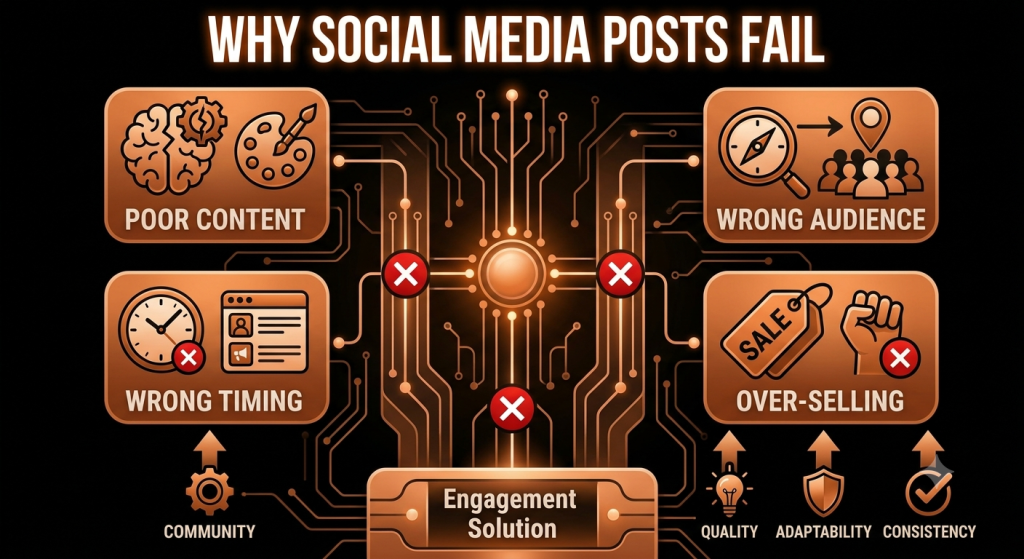
Why Your Social Media Posts Are Not Getting Engagement
You spend real time on a post — picking the image, writing the caption, checking it twice — and then you publish it and wait. No comments. No shares. Barely a handful of likes. It’s a frustrating, quiet kind of disappointment, and it happens to businesses of every size.
Low engagement rarely comes from one single mistake. It’s usually a mismatch somewhere between your audience, your content, your platform, your timing, or how you measure success. This guide walks through the most common reasons posts underperform, how to diagnose what’s actually happening on your account, and a practical plan to fix it.
What Does Social Media Engagement Actually Mean?
Engagement is any action someone takes in response to your content beyond simply seeing it. That includes:
- Likes
- Comments
- Shares
- Saves
- Replies
- Direct messages
- Profile visits
- Link clicks
- Mentions and tags
Engagement should never be judged by likes alone. A post with fewer likes but several saves and direct messages may actually be doing its job better than one with hundreds of likes and no real interaction.
It helps to think of the whole journey as a chain: reach leads to engagement, engagement can lead to traffic, traffic can lead to leads, and leads eventually become customers. Which metric matters most to you depends entirely on what you’re trying to achieve with that specific post.
Why Is Social Media Engagement Important?
Engagement is a signal of genuine audience interest. When people comment, share, or save your content, it usually means the content was relevant enough to be worth their time and attention.
- It shows whether your content is actually connecting with people
- It helps build community and ongoing brand relationships
- It acts as social proof for people discovering your page for the first time
- It gives you direct customer feedback in real time
- It can extend how far your content is distributed
- It can support website traffic and lead generation
That said, high engagement does not automatically translate into high revenue. A viral post can bring attention without bringing customers if it doesn’t attract the right audience. Engagement is a useful signal, not the end goal by itself.
15 Reasons Your Social Media Posts Are Not Getting Engagement
1. You Are Creating Content for Yourself Instead of Your Audience
There’s a big difference between asking “what do I want to post today?” and “what does my audience actually want or need right now?” A business owner might enjoy posting about a company milestone, while the audience is far more interested in a quick tip that solves a problem they have this week. Auditing your last few posts against your audience’s actual interests, not your own, is often the fastest way to spot this gap.
2. Your Content Does Not Provide Enough Value
Value can be educational, entertaining, inspirational, practical, emotional, or problem-solving — it doesn’t have to be all of them at once, but it should be at least one of them clearly. If a post doesn’t teach something, make someone smile, or solve a small problem, there isn’t much reason for a scrolling audience to stop and interact.
3. Your Opening Hook Is Weak
The first line of a caption, the first second of a video, or the first slide of a carousel decides whether someone keeps watching or scrolls past. “Here’s something we did last week” is a weak opening. “Here’s the mistake that cost us three clients before we fixed it” gives someone a reason to keep reading. No single hook guarantees a viral post, but a weak one guarantees most people never see the rest of your content.
4. Your Posts Are Too Promotional
Repeating “buy now,” “contact us,” and “limited offer” in every post trains your audience to tune you out. A healthier mix balances value content that teaches or entertains, engagement content that starts a conversation, and promotional content that actually asks for the sale — without treating every single post as a sales pitch.
5. You Are Not Speaking to a Specific Audience
Generic content trying to appeal to everyone usually connects with no one in particular. “5 tips for a better home” is generic. “5 things every renter in a small apartment should know before buying furniture” speaks to someone specific. The more precisely you can picture who you’re writing for — their problems, interests, and stage in the buying journey — the easier it becomes to write something that actually resonates.
6. Your Content Format May Not Match the Platform
Instagram audiences respond well to strong visuals and short video. LinkedIn audiences engage more with professional insight and personal stories tied to work. Facebook still rewards community and local relevance. YouTube and TikTok favour depth or fast entertainment depending on the format. Posting the exact same content, unchanged, across every platform usually underperforms compared to adapting the format to match how people actually use each one.
7. Your Visuals Are Not Strong Enough
Image and video quality, readability of text on screen, layout, consistent branding, and thumbnail or first-frame impact all affect whether someone stops scrolling. Visuals don’t need to look expensive, but they do need to be clear enough that the message isn’t lost in a blurry photo or cluttered design.
8. Your Captions Are Not Encouraging Conversation
A caption that ends with a genuine question, an opinion worth responding to, or a real choice (“which of these would you try first?”) invites people to comment. This is different from artificial engagement bait like asking people to comment an emoji for no real reason — that tactic tends to attract shallow, meaningless interaction rather than real conversation, and some platforms treat it as low-quality behaviour.
9. You Are Not Engaging With Your Audience
Social media is a two-way channel. If you post and disappear without replying to comments, answering questions, responding to messages, or joining relevant conversations in your niche, you’re missing half of what makes the platform work. People are far more likely to keep engaging with an account that visibly engages back.
10. Your Posting Strategy Is Inconsistent
Consistency is not the same as quantity. Posting daily for two weeks and then disappearing for a month does more damage than posting three times a week, every week, for a year. Choose a frequency you can actually sustain alongside producing content that’s still worth someone’s time.
11. You Are Posting at the Wrong Time for Your Audience
Timing can affect how many people see a post early on, which can influence its overall reach. But there is no universal “best time to post” that works for every business — it depends on when your specific audience is actually active. Your own platform analytics will tell you far more than a generic list of “best times” ever will.
12. You Are Chasing Followers Instead of the Right Audience
Follower count alone doesn’t tell you much about whether your content is working. A thousand followers who are genuinely interested in what you offer will engage more, and buy more, than fifty thousand followers who followed you for an unrelated giveaway. Audience quality and fit matter more than audience size.
13. You Are Not Using Data to Improve Your Content
Reach, engagement rate, saves, shares, comments, clicks, profile visits, and watch time all tell a story about what’s working. Reviewing your best and worst-performing posts side by side, and looking for patterns in topic, format, or timing, is one of the most reliable ways to improve future content.
14. You Keep Repeating the Same Type of Content
Posting the same format in the same style, week after week, can lead to a kind of fatigue where even your existing audience starts scrolling past without noticing. Trying different formats — video, carousel, single image, text post, poll, tutorial, or case study — helps you find what your specific audience actually responds to, rather than assuming one format works forever.
15. Your Content Does Not Have a Clear Purpose
Every post should be trying to do something specific: educate, entertain, build trust, start a conversation, generate a lead, drive traffic, or promote an offer. A post with no clear purpose tends to read as filler, and audiences are quick to sense filler content and scroll past it.
How to Fix Low Social Media Engagement
A structured recovery plan works better than randomly trying new tactics. Ten practical steps:
- Review your last 20–30 posts honestly
- Identify your best-performing content and why it worked
- Look for patterns across your top and bottom performers
- Revisit who your target audience actually is
- Rewrite your hooks to be more specific and interesting
- Create more content built around audience needs, not internal updates
- Test a different format you haven’t used much
- Start genuinely asking questions and starting conversations in captions
- Improve visual clarity and consistency across posts
- Review analytics regularly instead of only when something goes wrong
What Type of Content Gets More Engagement?
No single content type guarantees engagement — audience and context matter more than format. That said, these categories tend to perform consistently well across most niches:
- Educational content that teaches something specific
- Problem-solving content aimed at a real pain point
- Short videos and tutorials
- Behind-the-scenes and founder or team stories
- Customer experiences and testimonials
- Opinion-based content that takes a clear stance
- Questions and polls
- Industry insights and trends
- User-generated content
- Useful checklists and quick-reference content
- Case studies with realistic, honest outcomes
How to Write Social Media Posts That Encourage Engagement ?
A simple framework works across most platforms: Hook, then Value, then Context, then a Conversation or Call to Action.
A local restaurant might open with “We almost took this dish off the menu” (hook), explain the story and what makes it different (value and context), and close by asking which dish people want to see next (conversation). A consultant might open with a common mistake they see in client work, explain why it happens, and ask readers to share their own experience with it. A salon might show a quick before-and-after, explain the technique briefly, and ask which style people would try. The structure stays the same even as the topic changes.
Should You Post More Often to Get More Engagement?
More posts do not automatically mean more engagement. Posting frequency only helps when the content stays relevant and useful — otherwise it just increases the amount of low-value content your audience has to scroll past.
Quality, relevance, consistency, and audience fatigue all matter more than a specific number. A sustainable schedule you can maintain with genuinely useful content will outperform an aggressive schedule that burns out after a few weeks.
Does the Social Media Algorithm Cause Low Engagement?
Recommendation and distribution systems do influence which content gets shown to which users, but low engagement shouldn’t be blamed on “the algorithm” by default. These systems are generally built around user behaviour, content relevance, and existing engagement signals — content that people genuinely interact with tends to get shown to more people.
Nobody outside the platforms themselves knows the exact ranking formula, and it changes over time. The more reliable focus is on the things within your control: relevance, quality, and real interaction, rather than trying to reverse-engineer a system that isn’t publicly documented.
Does Having More Followers Mean More Engagement?
Not necessarily. Follower count and engagement are different metrics measuring different things. An account can have a large number of followers who no longer use the platform actively, followed for unrelated reasons, or simply aren’t part of the target audience.
A smaller account with a highly relevant, engaged audience will often show a stronger engagement rate than a much larger account with a broad, disengaged following. Engagement rate — engagement divided by reach or followers — tells you more about content health than raw follower numbers ever will.
How to Measure Social Media Engagement Properly
| Metric | What It Tells You |
|---|---|
| Engagement rate | How actively your existing audience interacts, relative to reach or followers |
| Likes, comments, shares, saves | Which specific posts resonate most |
| Clicks and profile visits | Whether content is driving curiosity or action |
| Video watch time | Whether content holds attention beyond the first few seconds |
| Direct messages | Whether content is prompting direct, private interest |
| Leads and conversions | Whether engagement is translating into business outcomes |
Choose the metrics that connect to your actual goal for that content. A brand-awareness post and a lead-generation post should not be judged by the same numbers.
A Simple Social Media Engagement Audit
Run through these questions honestly for your own account:
Audience
- Who are we actually creating content for?
- What problems or interests do they have?
Content
- Is the content genuinely useful?
- Is the hook specific and interesting?
- Is the message clear within the first few seconds?
Visuals
- Is the content easy to understand at a glance?
- Does the design support the message rather than distract from it?
Engagement
- Do we reply to comments and messages?
- Do we ask genuine questions that invite real answers?
Strategy
- Does each post have a clear purpose?
- Are we posting on a schedule we can actually maintain?
Analytics
- Which posts perform best, and why?
- Which formats consistently underperform?
- What patterns show up across the last month of posts?
A 30-Day Plan to Improve Social Media Engagement
Week 1 — Audit and Research
Review your last month of posts, identify your best and worst performers, and clarify exactly who your target audience is.
Week 2 — Content Improvement
Rewrite your hooks, add more audience-focused topics to your content plan, and improve visual consistency across posts.
Week 3 — Engagement and Community Building
Reply to every comment and message, ask genuine questions in your captions, and start participating in relevant conversations outside your own posts.
Week 4 — Testing and Measurement
Test one new format you haven’t used recently, review your analytics against Week 1’s baseline, and note which specific changes made a visible difference.
There’s no fixed percentage improvement to expect — results depend on your starting point, your niche, and how consistently you apply the changes.
Common Social Media Engagement Mistakes to Avoid
- Buying followers — better approach: grow a smaller, genuinely interested audience
- Buying engagement — better approach: focus on content that earns real interaction
- Using engagement pods or artificial tactics — better approach: build organic, relevant interaction
- Keyword or hashtag stuffing — better approach: use a few relevant tags naturally
- Posting irrelevant content — better approach: stay close to your audience’s real interests
- Posting only promotional content — better approach: balance value, engagement, and promotion
- Ignoring comments — better approach: reply consistently and promptly
- Copying competitors directly — better approach: build your own voice and angle
- Posting without a goal — better approach: give every post a clear purpose
- Obsessing over follower count — better approach: track engagement rate and leads instead
- Ignoring analytics — better approach: review performance on a regular schedule
- Expecting overnight results — better approach: plan for gradual, consistent improvement
Social Media Engagement for Small Businesses
Small businesses can improve engagement without a large marketing budget by leaning into what larger competitors often can’t replicate:
- Local, community-specific content
- Real customer stories
- Educational posts answering common questions
- Behind-the-scenes glimpses of the actual work
- Founder or team personality
- Genuine conversations with followers, not scripted responses
- User-generated content from happy customers
- Consistent, recognisable branding
- Repurposing one good piece of content into multiple formats
Authenticity and closeness to a specific community are real advantages for a smaller business — they’re often harder for larger, more impersonal brands to match.
Frequently Asked Questions About Social Media Engagement
Why are my social media posts not getting engagement?
It’s usually a combination of factors — content that doesn’t match audience interests, a weak hook, too much promotional content, inconsistent posting, or limited interaction from your own account, rather than one single cause.
Why did my social media engagement suddenly drop?
A sudden drop can follow a change in content type, a shift in posting consistency, seasonal audience behaviour, or a platform-wide change in how content is distributed. Reviewing what changed around the same time is the best starting point.
How can I increase social media engagement?
Focus on audience-relevant content, stronger hooks, genuine questions in captions, replying to comments consistently, and reviewing analytics regularly to repeat what’s working.
How often should I post on social media?
As often as you can maintain consistently while keeping content genuinely useful — there’s no universal number that works for every business.
Does posting every day increase engagement?
Not automatically. Frequent posting only helps when each post remains relevant and valuable; otherwise it adds volume without adding results.
What type of social media content gets the most engagement?
Educational, problem-solving, and story-driven content tend to perform well across most niches, but the right format depends on your specific audience and platform.
Why are my followers not liking my posts?
Followers may be inactive, may have followed for reasons unrelated to your current content, or may simply not find recent posts relevant enough to interact with.
Does the algorithm reduce social media reach?
Distribution systems do influence reach based on relevance and engagement signals, but low reach is more often tied to content and audience fit than a deliberate reduction.
Are hashtags still useful?
Used sparingly and relevantly, hashtags can help with discovery, but stuffing posts with unrelated tags does not meaningfully improve engagement and can look spammy.
Is follower count important for engagement?
Follower count matters less than audience relevance. A smaller, engaged, well-matched audience typically produces a stronger engagement rate than a large, disengaged one.
How long does it take to improve social media engagement?
Noticeable improvement usually takes a few weeks to a couple of months of consistent, adjusted effort — timelines vary by niche, starting point, and consistency.
How do I calculate social media engagement rate?
A common method is dividing total engagement (likes, comments, shares, saves) by reach or follower count, then multiplying by 100 to get a percentage.
Conclusion
Low social media engagement is usually not caused by one single problem. It’s often the result of a mismatch somewhere between your audience, your content, your platform, your strategy, and how you’re measuring success.
Instead of chasing likes alone, it helps to focus on a clearer chain: reaching the right audience, creating genuinely useful content, encouraging real interaction, testing consistently, and measuring the results honestly.
If your engagement has felt flat for a while, this is a good moment to run the audit above on your own last month of posts. Small, honest adjustments — a sharper hook, a real question in your caption, faster replies to comments — tend to add up faster than a complete strategy overhaul. And if you’d rather have an experienced team handle the strategy, content, and testing for you, that’s exactly the kind of ongoing work a social media marketing partner can take off your plate.