

How to Create Content That Builds Trust and Brings Leads
You’re publishing blog posts. Maybe you’re active on social media too. People are visiting your website. And yet the phone isn’t ringing much, and your inbox isn’t filling up with enquiries. If this sounds familiar, the problem usually isn’t a lack of content — it’s that the content isn’t doing what it needs to do.
It might not be useful enough. It might not be specific enough to your actual customers. It might not feel trustworthy, or it might just be missing a clear next step for someone who’s actually interested. People become leads when content helps them understand their problem, trust that you know what you’re talking about, and see a clear path forward from there.
That’s what this article is about — not just creating more content, but creating the kind that actually earns trust and turns into real enquiries.
Quick Answer: Trust-building content answers real customer questions, provides genuinely useful information, demonstrates knowledge and experience, addresses concerns and objections honestly, uses real examples or evidence where appropriate, and gives the reader a clear, relevant next step — rather than jumping straight into a sales pitch.
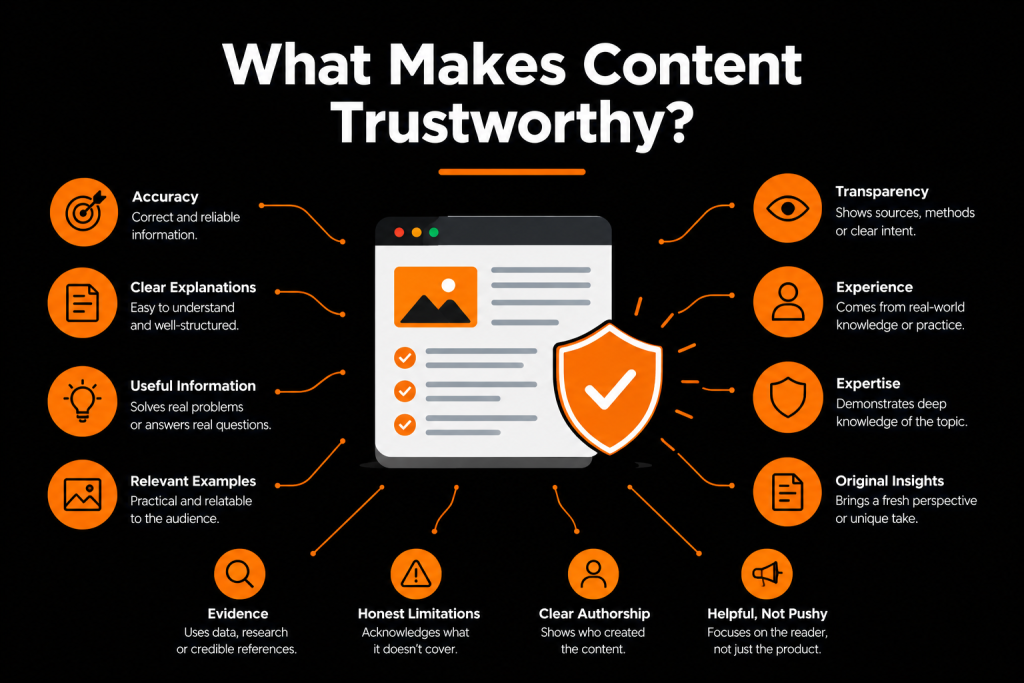
What Makes Content Trustworthy?
Trustworthy content is accurate first — getting the basics right matters more than sounding impressive. It explains things clearly, without unnecessary jargon getting in the way. It includes relevant examples that actually help the reader picture the situation, and it’s transparent rather than dressed up as something it isn’t.
It also shows real experience and expertise — not by claiming it, but by demonstrating it through the quality of the explanation itself. Original insight matters too, as does being honest about limitations instead of pretending every solution is perfect. And underneath all of it, the writing should feel genuinely helpful rather than overly promotional.
Why Does Trust Matter in the Buying Process?
Most people research a business before ever picking up the phone or filling out a form. They’re weighing risk, comparing options, and looking for reliable information that helps them feel confident in a decision that costs them time or money.
For example, someone searching for a website development company might first read guides about typical website costs, realistic development timelines, different CMS options, or common mistakes businesses make when building a site — long before they ever reach out to anyone. If your content is what answers those questions honestly, you’ve already built a head start on trust before the conversation even begins.
Start With Your Customer's Real Problems
The best content usually starts with a simple question: what is my customer actually struggling with right now? Not a topic that sounds good on a content calendar — a real, specific problem.
Good sources for this include the questions customers actually ask, what your search queries reveal, what your sales team hears repeatedly, common support questions, objections you hear before someone buys, and the basic beginner questions people are sometimes embarrassed to ask out loud. A plumber might notice customers frequently ask “how do I know if it’s actually an emergency,” which is a genuinely useful, specific topic — far more useful than a generic “plumbing tips” post.
Give People Real Answers, Not Just Sales Pitches
There’s a real difference between genuinely helpful content and promotional content dressed up to look helpful. A pricing article that avoids actual numbers and just says “contact us for a quote” isn’t really answering the question someone came with.
Honest content — covering pricing ranges, pros and cons, common mistakes, fair comparisons, real limitations, and things a customer should genuinely consider before buying — tends to build far more trust than content that avoids anything that isn’t flattering. Being straightforward, even about downsides, signals that you’re not just trying to close a sale.
Show Your Expertise Without Saying "We're the Best"
Claiming to be an expert does very little on its own. Demonstrating it through useful explanations, practical advice, original insight, concrete examples, data from reliable sources, honest case studies, and clear step-by-step guidance does far more.
A reader who finishes an article thinking “that actually made sense, and I learned something real” walks away trusting you more than one who reads a page full of “industry-leading” and “best-in-class” claims with nothing to back them up.
Use Examples That Help Readers Understand
Examples make abstract advice concrete. A before-and-after scenario, a simple hypothetical business situation, or a mini example tied to a real customer problem all help a reader picture exactly what you mean, rather than nodding along to something vague.
It’s worth being clear about one thing: if an example is fictional, say so. Never present an invented scenario as a real customer result — that’s the kind of thing that quietly destroys trust the moment someone notices.
Use Social Proof to Reduce Doubt
Genuine customer reviews, testimonials, real case studies, honest client feedback, actual results, and portfolio examples all help reduce hesitation — they show a reader that other people have already trusted you and had a good outcome.
This only works if it’s real. Fabricated reviews, invented statistics, or made-up results aren’t just dishonest — they undermine the whole point of building trust in the first place.
Create Content for Every Stage of the Customer Journey
Awareness stage: the person has a problem but may not know the solution yet. Beginner guides, educational blogs, how-to articles, videos, and basic FAQs work well here.
Consideration stage: the person is researching possible solutions. Comparisons, detailed guides, case studies, checklists, and expert articles serve this stage better.
Decision stage: the person is weighing a specific business or option. Service pages, product pages, clear pricing information, case studies, testimonials, FAQs, and consultation pages matter most here.
One type of content can’t realistically serve every stage well — trying to make a single beginner guide also close the sale usually means it does neither job particularly well.
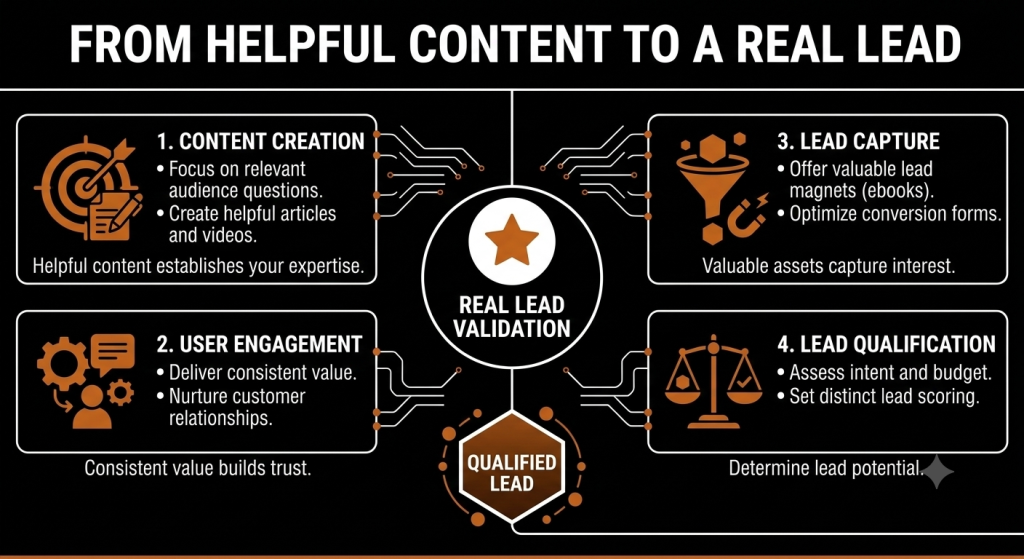
How to Turn Trust-Building Content Into Leads
Step 1: Attract the right audience. Write for the people who are actually relevant to your business, not just anyone searching a broad term.
Step 2: Solve their problem. Give useful information first, before thinking about the sale at all.
Step 3: Build credibility. Let the quality of the content itself demonstrate your expertise.
Step 4: Introduce the relevant solution. Once you’ve genuinely helped, connect the reader’s problem to what you actually offer — naturally, not abruptly.
Step 5: Give them a clear next step. Use a CTA that matches where they are in their thinking.
Step 6: Make the conversion easy. Simple forms, clear contact options, and straightforward booking processes remove friction right when someone’s ready to act.
Step 7: Follow up. Genuine follow-up — whether through email or a personal reply — helps nurture a lead who wasn’t quite ready to convert immediately.
How to Add CTAs Without Losing Trust
Not every article needs an aggressive “Buy Now.” The right CTA depends on the reader’s intent and where they are in their thinking.
Soft CTAs for early-stage content: “Read the related guide,” “Explore our services,” “Download the checklist,” “Learn more.”
Lead-generation CTAs for building interest: “Get the free guide,” “Request a consultation,” “Ask a question,” “Subscribe for useful tips.”
Strong CTAs for decision-ready content: “Contact us,” “Request a quote,” “Book a consultation.”
A strong CTA on a beginner-level article tends to feel out of place and can actually undermine trust rather than build it — matching the ask to the moment matters.
Content Types That Build Trust and Generate Leads
Educational blog posts and how-to guides help newer visitors and support search visibility. Case studies demonstrate real results and help people considering their options. FAQs answer specific hesitations quickly and directly. Comparison articles support people actively weighing choices. Checklists offer quick, practical value and work well as lead magnets. Videos and webinars build familiarity faster than text alone. Email newsletters keep interested people engaged over time. Service and product guides help decision-stage visitors. Original research and customer stories, when genuine, build strong credibility.
Each format does a slightly different job — matching the format to the reader’s stage tends to work better than treating every piece of content the same way.
A Simple Content Funnel
A useful way to hold this together: Helpful Content → Trust → Engagement → Relevant Solution → CTA → Lead → Follow-Up.
Someone finds genuinely helpful content, starts trusting your business as they read, engages further by exploring more, gets connected to a relevant solution, takes action through a well-matched CTA, becomes a lead, and is nurtured from there through honest follow-up.
How SEO Helps Trust-Building Content Reach the Right People
SEO isn’t about stuffing keywords into an article — it’s about matching genuinely useful content to what people are actually searching for. Search intent, sensible keyword research, strong topical relevance, thoughtful internal linking, and a good overall user experience all help the right people actually find your trust-building content in the first place.
Good SEO and good trust-building content support each other: content built around real questions naturally aligns with what people search for, and solid SEO fundamentals help that content actually get discovered.
Common Content Mistakes That Can Hurt Trust
- Writing only for search engines — producing content that reads awkwardly because it’s built around keywords, not people.
- Keyword stuffing — repeating phrases unnaturally instead of writing clearly.
- Making unsupported claims — stating things as fact without any real basis.
- Over-promoting products — turning every article into a pitch, which erodes trust fast.
- Copying competitors — instead of offering genuinely original insight.
- Publishing generic content — that could have been written by literally anyone, about anything.
- Ignoring customer questions — writing about what’s convenient instead of what people actually ask.
- Using clickbait headlines — promising something the content doesn’t actually deliver.
- Hiding important information — like avoiding real pricing or honest limitations.
- Weak or misleading CTAs — or CTAs that don’t match what the reader actually needs next.
- No proof or examples — leaving claims feeling abstract and unconvincing.
- Not updating outdated information — letting stale content quietly damage credibility.
- Publishing content without a clear audience — trying to speak to everyone and ending up connecting with no one.
- Using generic AI-generated content without adding real value — content that reads like everyone else’s, with nothing genuinely useful added on top.
A Simple Content Creation Process
- Understand your audience
- Identify their real problems
- Research the actual search intent behind those problems
- Choose a genuinely useful topic
- Create an accurate, honest outline
- Write content that’s genuinely helpful
- Add real examples and evidence
- Connect the content to a relevant solution
- Add a natural, well-matched CTA
- Optimize it for search
- Publish and distribute it
- Measure how it actually performs
- Improve it over time based on real results
How to Know If Your Content Is Bringing Leads
Useful signals include organic traffic, engagement, click-through rate, CTA clicks, form submissions, calls, consultation requests, email signups, conversion rate, qualified leads, assisted conversions, and revenue where it can be measured.
High traffic doesn’t automatically mean high-quality leads — an article can get plenty of visits and still convert very few of them. Focusing on business outcomes, not just visits, gives you a much more honest read on whether your content is actually working.
How Small Businesses Can Create Trust-Building Content
You don’t need a large team or a constant publishing schedule to make this work. A practical starting point includes real customer FAQs, common problems your customers face, service-related questions, beginner guides, local questions specific to your area, honest comparisons, genuine case studies, real testimonials, simple videos, and useful email content.
Consistency and genuine usefulness matter far more than publishing huge amounts of content. A handful of genuinely helpful pieces, kept up to date, can outperform a large volume of shallow ones.
A Realistic Fictional Example
Consider a fictional digital marketing agency. A potential client searches “how much does SEO cost,” and finds a genuinely honest article explaining typical pricing factors, without dodging the question. Trusting the straightforwardness, they read a related guide on what a realistic SEO timeline looks like.
From there, they visit the agency’s SEO service page, notice a few genuine client testimonials, and request a consultation through a clear, low-pressure CTA. The agency follows up personally, answering their specific question rather than sending a generic pitch, and eventually the relationship turns into a client.
This is a hypothetical, illustrative example — not a guarantee of results, and no specific outcome is implied for any real business.
Frequently Asked Questions
How does content build trust?
Content builds trust by genuinely answering real questions, being honest about pros and cons, demonstrating real expertise through clear explanations, and using genuine examples or evidence rather than vague claims.
What type of content generates leads?
Content tied to a clear next step tends to generate leads best — detailed guides, comparisons, case studies, and FAQs that address real hesitations, paired with a CTA matched to where the reader is in their decision.
How can content marketing generate leads?
By attracting the right audience with genuinely useful content, building trust through honest and helpful information, and then offering a relevant, easy next step once that trust has been established.
What makes content trustworthy?
Accuracy, clear explanations, honest limitations, real examples, and genuine expertise demonstrated through the writing itself — rather than the content simply claiming to be trustworthy or authoritative.
How often should a business publish content?
There’s no universal number — consistency and genuine usefulness matter more than frequency. A smaller amount of genuinely helpful content tends to outperform a large volume of shallow posts.
How do you turn blog readers into leads?
By giving real value first, building credibility through the quality of the content, connecting the reader’s problem to a relevant solution, and offering a clear, appropriately matched call to action.
What is the best content for lead generation?
It depends on the reader’s stage — comparisons and case studies work well for people actively researching, while FAQs and service pages tend to work better for people closer to a decision.
Can small businesses use content marketing?
Yes, and often quite effectively. Small businesses don’t need large volumes of content — a focused set of honest, genuinely useful pieces addressing real customer questions can work very well.
Should every blog post have a CTA?
Most benefit from some kind of next step, but it doesn’t need to be a hard sell every time. Matching the CTA to the content’s stage — soft for early content, stronger for decision-stage content — tends to work better.
How long does content marketing take to generate leads?
It varies by industry, competition, and consistency, but meaningful lead generation from content typically builds over months rather than appearing immediately after publishing.
Conclusion
Good content isn’t simply content that gets clicks. It helps the right people understand their problem, gives them genuinely useful answers, builds trust through honesty and real expertise, and offers a clear next step once they’re ready for one.
If you’re getting traffic but not many enquiries, that gap is usually worth a closer look — is your content actually answering real questions honestly, or does it read more like a pitch wearing a helpful costume? Taking an honest pass through your existing content with that question in mind is often the fastest way to find where trust is quietly slipping away.