
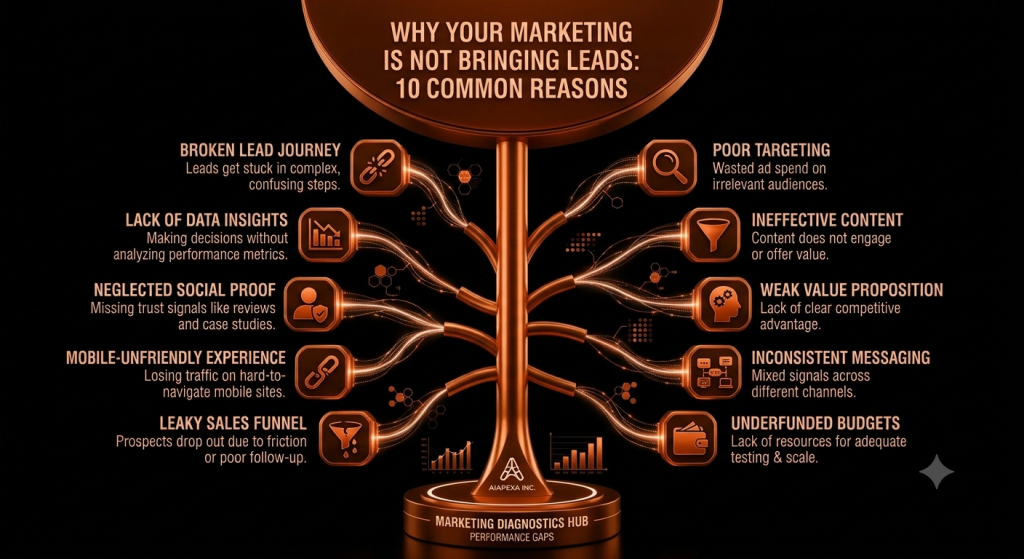
Why Your Marketing Is Not Bringing Leads: 10 Common Reasons
You are paying for ads, posting on social media, maybe even writing a blog. And still the phone stays quiet. It is frustrating, and it makes you wonder if marketing works for your kind of business at all.
Here is the honest part: spending money on marketing does not automatically bring leads. Most of the time the channel is not the real problem. The trouble sits somewhere in between: who you target, what you say, what you offer, how your website behaves, or what happens after someone shows interest. Figuring out why marketing is not bringing leads means finding which of those pieces is broken. These are the ten reasons that come up again and again, and what you can do about each.
Quick Answer: Why Is Your Marketing Not Bringing Leads?
Marketing usually fails to bring leads because something in the journey does not match the customer: the wrong audience, a weak offer, unclear messaging, a website that does not convert, missing trust, the wrong channel, a weak call-to-action, slow follow-up, inconsistent effort, or no tracking. Find the weakest stage and fix that first, instead of changing everything at once.
Marketing Activity Does Not Always Mean Marketing Results
Being busy is not the same as being effective. A lot of businesses confuse the two.
- Traffic is not leads. 5,000 monthly visitors sounds great until you notice nobody fills in the form.
- Likes are not customers. A reel with thousands of views can bring zero enquiries if people do not know what to do next.
- Running ads is not the same as getting qualified enquiries. Clicks from people who can never buy from you still cost money.
- Publishing content is not generating business. Posts need to speak to a real buying problem.
- Having a website is not having a website that converts. A good-looking site that gives no reason to act is just a brochure.
The goal of marketing is not simply to be visible. It is to attract the right people and help them take the next step.
1. You Are Targeting the Wrong Audience
Reaching more people is not the same as reaching the right people. Broad reach counts everyone who sees you. Relevant reach counts people who need what you sell, can afford it and live where you work. When targeting is loose, you attract students, browsers and bargain hunters, and the leads you do get are low quality. Example: an interior designer in Pune runs ads for a premium service to “everyone aged 22 to 60 in India.” Most enquiries ask for free ideas or the cheapest quote.
How to Spot It
Read your last 20 enquiries. If many are outside your area, budget or need, targeting is off. Also check ad reports by location, age and search terms.
How to Fix It
Write down your ideal customer in a few lines: their problem, location, budget and what makes them ready to buy now. Then narrow your targeting to match and exclude people who clearly do not fit.
2. Your Marketing Message Is Too Generic
“Best quality service.” “Affordable solutions.” “Grow your business.” Every competitor says the same things, so visitors learn nothing. A clear message covers the customer’s problem, your solution, the benefit, what makes you different and the outcome they want.
Before: “We offer affordable accounting solutions for growing businesses.”
After: “Monthly bookkeeping and GST filing for small shops, so you stop worrying about deadlines and notices.”
How to Spot It
Show your homepage headline to someone outside your industry for five seconds. If they cannot tell what you do and who it is for, it is too vague.
How to Fix It
Rewrite your main headline using this pattern: what you do, for whom, and the result they get. Then use the same idea across ads, social bios and landing pages.
3. Your Offer Is Not Strong Enough
An offer is the reason someone should act now instead of later or never. “Contact us” asks a stranger to take a risk. A better offer lowers that risk and gives something useful: a free consultation, site audit, demo, estimate, trial, guide, assessment or a fair introductory package. It has to be honest. Fake discounts and inflated promises attract the wrong people and damage trust. Example: a dental clinic changes “Book an appointment” to “Book a 20-minute check-up and get a clear treatment plan with cost estimate.”
How to Spot It
Ask yourself what a visitor actually gets by contacting you. If the answer is just “a sales call,” the offer is weak.
How to Fix It
Create a low-commitment first step that shows your expertise and solves a small part of the problem. Make sure you can deliver it properly every time.
4. Your Website Is Getting Visitors but Not Converting Them
Traffic means people arrive. Conversion means they do something. Common problems are unclear headlines, weak buttons, confusing navigation, slow or awkward mobile pages, no trust signals, too many distractions and long forms. Example: a coaching site sends all its ad clicks to a homepage with ten menu links and an eight-field form. Visitors wander and leave.
A lead-focused landing page usually has:
- A clear headline that matches the ad or search
- A short explanation of the benefit
- One main call-to-action
- Proof such as reviews or results
- A short form
- Fast loading on mobile
How to Spot It
Divide leads by visitors to get your conversion rate. Open your site on your own phone, and if you can, watch session recordings to see where people drop off.
How to Fix It
Fix one key page at a time. Give it one goal, one clear button and fewer form fields, then compare results.
5. You Are Using the Wrong Marketing Channel
Different audiences behave differently. Someone with a leaking pipe searches on Google. Someone browsing for a dress may find a boutique on Instagram. Google Ads can reach people searching right now, while SEO builds slowly but keeps working. Social media and Meta Ads suit awareness and visual products. Email works best with people who already know you. Content marketing builds trust over time, and local marketing helps neighbourhood businesses. No channel is best for everyone. Example: a plumber spends months on Instagram reels while customers are searching “plumber near me.”
How to Spot It
Ask every new lead how they found you, and compare leads by source instead of by activity.
How to Fix It
Go where your buyers are already looking. Put most of your effort into one or two channels and do them properly before adding more.
6. Your Content Is Not Addressing Customer Problems
If every post says “Call now,” people scroll past. Educational content answers questions. Trust-building content shows how you work through case studies and client stories. Promotional content presents offers. You need all three, but educational content reaches people earlier, before they are ready to buy. Blogs, videos, FAQs, guides, case studies and social posts can all support lead generation. Example: a solar installer publishes “What to check before signing a solar contract.” People reading it are already close to a decision.
How to Spot It
Look at your last ten posts. How many answer a real customer question?
How to Fix It
List the questions customers ask before buying, turn each into content, and end every piece with a clear next step.
7. People Do Not Trust Your Business Yet
Most people research before they enquire. They read reviews, open your About page and scroll your portfolio. If they cannot find proof that you are real and good at what you do, they leave quietly. Trust comes from:
- Genuine reviews and testimonials
- Case studies and portfolio work
- Clear business details: address, phone, team
- An About page with real people
- Helpful content that shows expertise
- Clear pricing or process where it makes sense
- A professional, secure, working website
How to Spot It
Search your business name like a stranger would. What do you find in the first few minutes?
How to Fix It
Ask happy customers for reviews, publish two or three honest case studies and put your real contact details where they are easy to find.
8. Your Call-to-Action Is Weak or Missing
A call-to-action (CTA) tells visitors what to do next. Without one, most will simply do nothing. Compare these:
“Submit” → “Request a Free Consultation”
“Learn More” → “See How Our SEO Service Works”
A CTA should also match the stage. A first-time blog reader may want a checklist. Someone on a pricing page is probably ready for a quote.
How to Spot It
On each page, can you spot the main button within three seconds? If not, neither can your visitors.
How to Fix It
Use one main CTA per page, write it in specific words, and repeat it at natural points.
9. You Are Not Following Up With Leads Properly
Getting a lead is only the beginning. If someone enquires and hears back days later, they have likely spoken to someone else by then. Reply as quickly as you realistically can, by email, phone or WhatsApp where customers expect it. Many leads are not ready on day one, so a little nurturing with helpful messages keeps you in mind. Example: a wedding photographer receives most enquiries on weekends but replies on Monday, after couples have already booked someone else.
How to Spot It
Check your last ten leads. How long did the first reply take? Did any go cold without a second message?
How to Fix It
Assign one person to every lead, set a reply standard you can keep, and use a simple CRM or shared spreadsheet showing name, source, status and next step.
10. You Are Not Tracking What Is Actually Working
Without data you are guessing. Useful numbers include website traffic, leads, conversion rate, cost per lead, qualified leads, lead-to-customer rate, customer acquisition cost, ad performance and landing-page performance. Likes, impressions and traffic alone can look great while the business gets nothing. Example: two campaigns cost the same. Campaign A brings 40 leads and one customer. Campaign B brings 15 leads and five customers. Cost per lead says A wins, but B is clearly better.
How to Spot It
Can you say how many leads you got last month, where each came from and how many became customers? If not, tracking needs work.
How to Fix It
Set up form and call tracking, label your lead sources, and review the numbers once a month.
How to Find Out What Is Actually Wrong With Your Marketing
Look at the journey from left to right: Traffic → Targeting → Message → Offer → Landing Page → CTA → Lead → Follow-Up → Sale. The first stage where things clearly fall apart is where you should start.
- Traffic: Are the right people visiting? Where are they coming from?
- Targeting: Are we showing up for people who actually need this?
- Message: Do visitors understand what we offer within a few seconds?
- Offer: Is it relevant enough to make someone act?
- Landing page: Is it convincing, fast and easy on mobile?
- CTA: Is the next step obvious?
- Lead: Are forms and calls coming in, and are they the right kind?
- Follow-up: Are leads contacted quickly and more than once?
- Sale: Are qualified leads turning into customers?
The Marketing Funnel in Simple Words
A funnel is just the path people take from first hearing about you to buying again. Awareness: they discover you. Interest: they find you relevant. Consideration: they compare you with others. Lead: they raise their hand. Customer: they buy. Repeat customer: they come back. A problem at any stage limits the final result. Great awareness with weak trust will not help, and neither will good ads sending people to a poor page.
How to Fix a Marketing Strategy That Is Not Generating Leads
Step 1: Define the ideal customer
Describe who they are, what problem they have and what makes them ready to buy.
Step 2: Review your current marketing channels
Compare leads by source. Keep what brings good enquiries and pause what does not.
Step 3: Check your messaging
Make sure your main headline says what you do, for whom and why it matters.
Step 4: Improve your offer
Give people a clear, honest, low-risk reason to get in touch.
Step 5: Audit your website or landing page
Check speed, mobile view, headline, form length and clarity of the main goal.
Step 6: Improve your CTAs
Replace vague buttons with specific ones that match what the visitor wants.
Step 7: Build trust
Add reviews, case studies, real contact details and team information.
Step 8: Improve lead follow-up
Decide who replies, how fast and what the second message says.
Step 9: Track meaningful metrics
Focus on qualified leads, cost per lead and lead-to-customer rate, not just traffic.
Step 10: Test and improve consistently
Change one thing at a time, give it enough time, and keep what works.
How Long Does It Take for Marketing to Generate Leads?
There is no fixed answer, and anyone who promises one is guessing. Timelines depend on your industry, audience, channel, budget, competition, offer, website, existing brand awareness, sales process and consistency. Paid ads can bring enquiries sooner, but they usually need testing before they become profitable. SEO and content marketing generally take longer to build. Whatever the channel, judge it over a sensible period and look at the trend, not just one week.
Marketing vs Lead Generation
Marketing attracts people and builds interest. Lead generation encourages potential customers to take a step you can measure, like filling a form or booking a call.
| Marketing | Lead generation | |
| Purpose | Attract and build interest | Encourage a measurable next step |
| Example | A useful blog post or video | A consultation request or quote form |
| Measured by | Reach, engagement, awareness | Enquiries, qualified leads, cost per lead |
Both need to work together. Marketing without a next step creates attention that goes nowhere. Lead generation without trust asks strangers to act too early.
SEO, AEO and GEO: How Modern Search Supports Lead Generation
SEO
Useful, relevant content built around what people search for can help you reach those who are already looking for solutions. It takes time, and no one can guarantee rankings.
AEO
Answer engine optimization simply means answering customer questions clearly and directly. Short, direct answers followed by more detail help both readers and answer-focused search features.
GEO
AI-generated search experiences tend to pull from content that is clear, accurate and well structured. Use plain headings, define terms, and back your claims with real information. There are no guarantees of AI visibility, but clear content helps people too.
Show Real Experience and Expertise
Search engines and readers both look for signs that content comes from someone who knows the subject. This is often called E-E-A-T: experience, expertise, authoritativeness and trustworthiness. You can show it through:
- Real examples from your own work
- Helpful, accurate content
- Author names and short bios
- Case studies and reviews
- Transparent information about your process
- Honest claims and original insights
A Fictional Example: The Local Cleaning Business
- Targeting: ads are shown across the whole state, including areas the team never visits
- Message: the ad says “Best cleaning services”
- Landing page: the ad goes to the homepage, which loads slowly on phones
- CTA: the only button says “Submit”
- Follow-up: enquiries are answered the next day, sometimes later
- Tracking: nobody knows which ad produced which lead
The improvements are simple. Limit ads to the service area. Change the message to “Deep cleaning for 2–3 BHK homes, with a fixed quote before we start.” Build a dedicated page with reviews and a short form. Change the button to “Get My Free Quote.” Reply to new leads on the same day using WhatsApp, and track each lead’s source in a spreadsheet. Nothing here is fancy, yet the whole path becomes clearer for the customer.
Marketing Lead Generation Checklist
- ☐ Are we targeting the right audience?
- ☐ Do we know our ideal customer’s main problem?
- ☐ Does our message say what we do and for whom?
- ☐ Is our offer clear and honest?
- ☐ Does our website explain the benefit quickly?
- ☐ Does it work well on mobile?
- ☐ Is our main CTA easy to find?
- ☐ Are we building enough trust?
- ☐ Are we using the channels our customers use?
- ☐ Are we tracking every lead and its source?
- ☐ Are we following up quickly and more than once?
- ☐ Are we measuring qualified leads, not just traffic?
- ☐ Are we testing different messages?
- ☐ Are we improving based on data?
Common Marketing Mistakes to Avoid
- Chasing every channel at once, so none gets enough effort
- Focusing only on followers
- Copying competitors without knowing if it works for them
- Changing strategy every few weeks
- Ignoring the website
- Using generic messaging
- Ignoring leads you already have
- Not measuring conversions
- Expecting instant results from every channel
- Focusing on traffic rather than business outcomes
Frequently Asked Questions
Why is my marketing not generating leads?
Usually because of a gap between what you offer and what the right audience needs. Common causes are the wrong targeting, unclear messaging, a weak offer, poor website conversion, missing trust, slow follow-up or no tracking.
Why am I getting traffic but no leads?
Visitors may not be the right people, or your page may not convince them. Check whether the headline is clear, whether the CTA stands out, whether trust signals are present and whether the form is easy to complete.
How can I get more qualified leads?
Define your ideal customer, target them more precisely, and make your message specific. Add a clear offer, qualify enquiries with a few useful form questions, and track which sources send the best leads.
Why are my ads not generating leads?
Ads often fail because of loose targeting, a vague message or a landing page that does not match the ad. Weak offers and slow follow-up also matter. Review each stage before increasing the budget.
How can I improve my website conversion rate?
Make the headline clear, keep one main goal per page, use a specific CTA, shorten forms, add proof, and check mobile speed. Change one thing at a time so you know what made the difference.
How do I know if my marketing strategy is working?
Look beyond likes and traffic. Track qualified leads, cost per lead, lead-to-customer rate and customer acquisition cost. If those improve over time, the strategy is moving in the right direction.
What is the biggest mistake businesses make in lead generation?
Focusing on activity instead of the customer’s journey. Posting, advertising and redesigning without checking who arrives, what they understand and what happens after they enquire usually wastes effort.
Should I focus on SEO, social media or paid advertising?
It depends on where your customers look and how fast you need results. Start with the channel closest to buying intent, often search or local visibility, and add others once it works.
Final Thoughts
When marketing is not bringing leads, the answer is rarely to spend more or try something completely new. Start by looking at the path your customer takes, find the point where people drop off, and fix that one thing. Small, steady improvements usually beat big, random changes.