
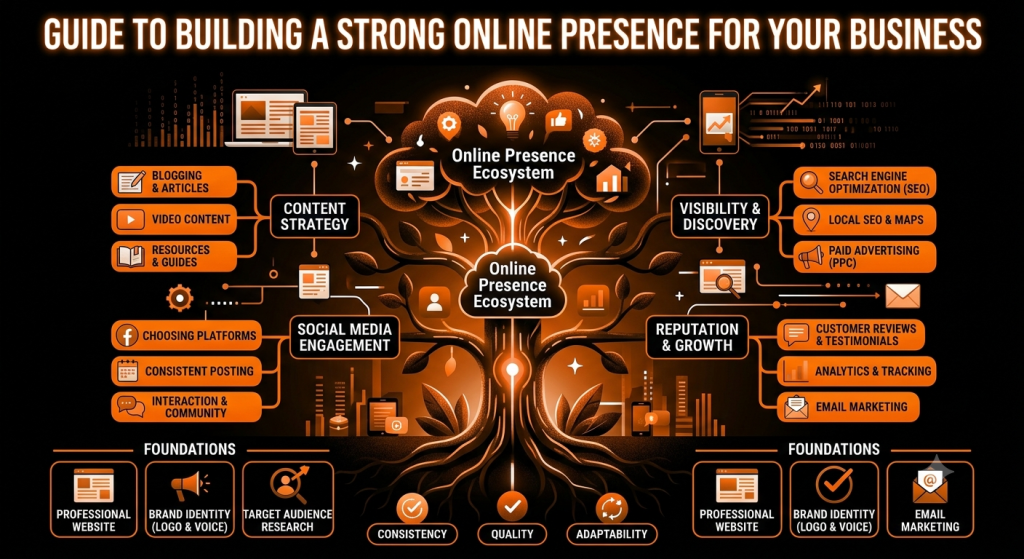
How to Build a Strong Online Presence for Your Business
Someone hears about your business from a friend, a signboard, or a passing mention online. Before they call or walk in, they search your name. If what they find is an outdated website, no reviews, a dead social page, or nothing at all, they quietly move on to a competitor who looked more established — even if your actual product or service is better.
This happens constantly, and it’s rarely about one big failure. It’s usually a collection of small gaps: a website that hasn’t been touched in years, a Google profile that’s half-filled, reviews that went unanswered. None of these alone sinks a business, but together they quietly cost you customers you never even knew you lost.
A strong online presence fixes that. It’s not about being everywhere at once — it’s about being visible, credible, and easy to engage with wherever a potential customer happens to look. This guide walks through what that actually involves: your website, search visibility, local SEO, social media, content, reviews, branding, and how to tie it all together into something you can realistically maintain.
What Is an Online Presence?
An online presence is the full picture of how your business shows up online — not just a website, but everything a potential customer might encounter while researching you.
That includes your website, how you appear in search engines, your Google Business Profile, your social media accounts, listings on business directories, customer reviews, any content you publish, your email communication, and your overall online reputation.
A strong online presence looks like this in practice: a customer searches your business name, finds an accurate Google profile with recent photos and reviews, clicks through to a website that loads quickly and clearly explains what you offer, and maybe notices an active, relevant social account along the way. Every touchpoint tells the same, consistent story.
Why Is a Strong Online Presence Important for Your Business?
A well-built online presence supports real business outcomes, even though being online by itself doesn’t automatically produce customers. It helps by:
- Making you easier to find when someone is actively looking
- Building trust before a customer ever speaks to you directly
- Reaching new customers beyond your existing network
- Increasing overall brand awareness in your market
- Generating leads through your website and profiles
- Supporting sales by answering questions before someone asks them
- Helping smaller businesses compete with larger, better-funded ones
- Improving how customers reach and communicate with you
- Building long-term brand credibility, not just short-term traffic
The businesses that benefit most treat this as ongoing work connected to real goals, not a checklist to complete once and forget.
1. Create a Professional Business Website
Your website is usually the foundation everything else points back to. It should have professional design, clear messaging, a genuine about page, a clear list of services or products, visible contact information, obvious calls to action, testimonials, and other trust signals.
Easy navigation, fast loading, mobile responsiveness, and a secure HTTPS connection aren’t optional extras — they’re baseline expectations now. Within a few seconds of landing on your homepage, a visitor should understand what you do, who it’s for, and what to do next.
2. Optimize Your Website for Search Engines
SEO is the practice of helping search engines understand and rank your pages while also giving visitors a genuinely good experience. That starts with keyword research grounded in real search intent, then carries through to title tags, meta descriptions, clear headings, genuinely helpful content, sensible internal linking, and optimized images.
Technical SEO — page speed, mobile usability, and structured data where it’s appropriate — matters too, since none of your content helps if search engines can’t properly access or understand it. No one can honestly guarantee a specific ranking; what consistent SEO work does is steadily improve your odds of being found.
3. Focus on Local SEO
If your business serves a specific area, local SEO is often the fastest route to genuinely interested customers. It covers your Google Business Profile, local keywords, reviews, accurate business information, local citations, location pages, Google Maps visibility, and local content.
Think about how people actually search: “digital marketing agency in Lucknow,” “best salon near me,” “plumber in [city],” “restaurant near me.” These are high-intent searches — the person is usually close to making a decision, not just browsing, which is exactly why local visibility matters so much.
4. Build a Strong Google Business Profile
Your Google Business Profile is often the first real impression a potential customer forms of your business. Keep it accurate and complete: business name, category, address or service area, phone number, website, hours, photos, your list of services or products, and genuine reviews. Post updates where relevant.
Avoid fake reviews, misleading information, or keyword-stuffed business names — these violate Google’s guidelines and put your whole profile at risk. And no profile optimization, however thorough, guarantees a specific ranking position.
5. Build a Consistent Social Media Presence
Social media supports visibility and, more importantly, ongoing customer relationships. Choose platforms based on where your target audience actually spends time, your industry, the content formats you can realistically produce, and the resources you have — not every business needs to be on every platform. Facebook, Instagram, LinkedIn, YouTube, TikTok, and X each suit different audiences and goals.
What matters more than platform count is consistent branding, genuinely useful posts, real engagement, responding to customers, and a mix of visual and video content that reflects how you actually operate.
6. Create Helpful and Relevant Content
Content marketing means creating material that answers the real questions, problems, and needs your customers have — blog posts, guides, tutorials, case studies, FAQs, videos, infographics, checklists, and social posts.
A repair business might publish a maintenance checklist; a consultancy might publish a short case study; a salon might answer the questions customers ask most during a consultation. The pattern that works is starting from a real customer question, not a keyword list.
7. Build Trust Through Reviews and Testimonials
Reviews shape whether a stranger trusts you enough to make contact. Ask genuine customers for feedback, make the process easy, respond professionally to every review, and handle negative feedback calmly rather than defensively. Display legitimate testimonials on your website where relevant.
Avoid fake or purchased reviews entirely — they damage trust the moment they’re discovered, and platforms actively penalize them. Reputation management, done honestly, is simply part of maintaining a strong online presence.
8. Keep Your Brand Consistent Everywhere
Your business name, logo, colors, tone, contact information, and core message should look and sound the same across your website, social media, Google Business Profile, directories, email, and advertisements.
Inconsistency — a different phone number here, a slightly different business name there — creates confusion and quietly erodes trust, even when the underlying business is solid.
9. Make Your Online Presence Mobile-Friendly
Most customers now interact with businesses primarily through a phone. Responsive design, fast pages, readable text, simple navigation, click-to-call buttons, easy forms, and accessible contact information all need to work well on a small screen, not just a desktop monitor.
Mobile experience shouldn’t be treated as an afterthought tacked onto a desktop-first design — for most businesses, it’s the primary experience customers actually have.
10. Use Email Marketing to Stay Connected
Email supports the relationships you’ve already started. Welcome emails, newsletters, promotions, educational content, product updates, lead nurturing, and follow-ups all keep you present without requiring a customer to remember to check your website.
The businesses that get the most out of email focus on providing genuine value regularly, rather than sending excessive promotional messages that train people to stop opening them.
11. Use Video to Increase Engagement
Video complements the rest of your online presence well — product demonstrations, tutorials, behind-the-scenes content, customer stories, educational explainers, FAQs, and short-form clips all help demonstrate expertise and build familiarity faster than text alone.
It doesn’t need to be highly produced to work. Clear, useful, and genuine usually outperforms polished but generic.
12. Consider Paid Advertising
Paid advertising — Google Ads, social media ads, remarketing, or local advertising — buys immediate visibility rather than the organic visibility that builds over time through SEO and content.
It works best with a clear objective, a defined audience, a landing page built for that specific campaign, and a way to actually measure results. Spending on ads without those pieces in place usually produces traffic without producing outcomes.
13. Build a Strong Online Reputation
Reputation management covers reviews, customer feedback, what shows up in search results about you, social media mentions, and how you respond publicly. Consistent, professional communication across all of it builds credibility over time.
When negative feedback appears — and eventually it will — respond calmly, acknowledge the concern, and offer to resolve it. How a business handles criticism publicly often matters more to onlookers than the original complaint itself.
14. Track Your Online Performance
Measurement is what turns online presence work from guesswork into a real strategy. Track website traffic, organic traffic, search impressions and clicks, leads, calls, form submissions, conversion rate, social engagement, email performance, and Google Business Profile interactions.
Be careful not to confuse vanity metrics — follower counts, raw traffic numbers — with actual business results like enquiries, bookings, and sales. The numbers that matter are the ones tied to real outcomes.
A Step-by-Step Online Presence Strategy for Small Businesses
- Define your target customer — be specific about who you’re trying to reach.
- Clarify your brand message — know what you want people to understand about you.
- Build or improve your website — make it the solid foundation everything else points to.
- Set up and optimize Google Business Profile — complete every section accurately.
- Research relevant search terms — find out what your customers actually type.
- Improve your SEO — work on both content and technical health.
- Choose the right social platforms — go where your audience already is.
- Publish useful content — answer real customer questions.
- Collect genuine reviews — ask, make it easy, and respond.
- Build your email audience — start capturing contacts you can nurture.
- Test paid advertising when appropriate — once you have a clear goal and a way to measure it.
- Measure and improve — review what’s actually working and adjust.
How to Build an Online Presence With a Limited Budget
You don’t need to be everywhere to build real online presence — especially with limited time or money. If you need to prioritize, focus first on:
- Website fundamentals — clear, fast, and mobile-friendly
- Google Business Profile — free, and often the highest-impact effort available
- Local SEO — especially if you serve a specific area
- Helpful content — even a handful of genuinely useful pages
- One or two relevant social platforms — chosen deliberately, not by default
- Reviews — low-cost and high-trust
- Basic analytics — so you can see what’s actually working
Doing a handful of things consistently well beats spreading limited resources across everything at once.
Common Online Presence Mistakes Businesses Should Avoid
- Having an outdated website — refresh it regularly rather than letting it sit untouched for years.
- Ignoring mobile users — test and fix the mobile experience directly.
- Using inconsistent business information — keep name, address, and phone identical everywhere.
- Being inactive on important platforms — an abandoned profile can look worse than no profile at all.
- Creating content without understanding customers — start from real customer questions instead.
- Buying fake reviews — earn them genuinely instead.
- Keyword stuffing — write for people first.
- Copying competitors — build your own voice and insight instead.
- Focusing only on followers — track outcomes that actually matter to the business.
- Ignoring customer feedback — respond to it, publicly and privately.
- Running ads without tracking conversions — set up measurement before you spend.
- Expecting instant SEO results — give consistent work the time it needs.
How Long Does It Take to Build a Strong Online Presence?
Building an online presence is an ongoing process, not a one-time project you finish and move on from. Different activities move at different speeds — a Google Business Profile update can show effects quickly, while SEO and content authority typically build over months.
How fast you see results depends on your industry, competition, location, website quality, existing authority, content quality, consistency, and budget. No one can honestly promise a specific ranking, traffic level, or revenue increase — what’s realistic is steady improvement from consistent, genuine effort.
How to Know If Your Online Presence Is Working
A useful way to evaluate your efforts is to follow the path from Visibility → Engagement → Leads → Customers. Visibility is whether people can find you at all. Engagement is whether they interact once they do — clicks, calls, messages, follows. Leads are whether that interaction turns into a genuine enquiry. Customers are whether that enquiry becomes an actual sale or booking.
If you’re seeing visibility but no engagement, the impression you’re making needs work. If you’re seeing engagement but no leads, something in your offer or follow-up may need attention. Tracking each stage separately shows you exactly where to focus next.
Where to Go From Here
If you’re not sure where your own online presence currently stands, start with a simple review: search your own business name, check your Google Business Profile, and look at your website through a first-time visitor’s eyes. That alone usually reveals the most obvious gaps to fix first.
Frequently Asked Questions
What is an online presence?
An online presence is the full picture of how your business appears online — your website, search visibility, Google Business Profile, social media, reviews, and content, all taken together.
Why does a business need an online presence?
Because most customers research a business online before contacting it. A weak or missing online presence often means losing that customer to a competitor who looks more established.
How can I build an online presence for my small business?
Start with the fundamentals: a clear website, a complete Google Business Profile, basic local SEO, and a couple of genuine reviews. Expand from there as time and budget allow.
Is a website necessary for a small business?
In most cases, yes. It’s usually the one place you fully control, where you can clearly explain what you offer and give visitors a way to contact you.
How does SEO improve online visibility?
SEO helps search engines understand and rank your pages for relevant searches, which increases the chances that potential customers find you organically over time.
Does social media help build an online presence?
Yes, particularly for visibility and ongoing customer relationships — but only on platforms where your actual audience spends time, used consistently.
How important are online reviews?
Very. Reviews strongly influence whether a stranger trusts you enough to make contact, and they also support your visibility in local search.
How can I improve my local online presence?
Focus on a complete, accurate Google Business Profile, consistent business information everywhere it’s listed, genuine local reviews, and content relevant to your area.
How long does it take to build an online presence?
It’s an ongoing process rather than a one-time task. Some improvements show up within weeks; deeper authority and rankings typically build over months of consistent work.
How much does it cost to build an online presence?
Costs vary widely depending on whether you handle it yourself or bring in outside help, and how competitive your industry and location are. There’s no fixed number for every business.
What should a small business focus on first?
Website fundamentals, a complete Google Business Profile, and basic local SEO tend to offer the strongest return for the effort involved, especially early on.
How can I measure my online presence?
Track website traffic, search impressions and clicks, leads, calls, form submissions, conversion rate, and Google Business Profile interactions — and connect those numbers to real business outcomes.
Conclusion
A strong online presence isn’t created by being active everywhere at once. It comes from being visible, useful, trustworthy, consistent, and easy for customers to engage with — across a website, search, local listings, social media, and the way you handle reviews and follow-up.
None of it is a one-time project. It’s ongoing work that compounds over time, and it rewards businesses that stay consistent more than those that make one big push and stop. If you haven’t reviewed your online presence in a while, that review is usually the best place to start.