Google Ads vs SEO: Which One Is Better for Your Business?
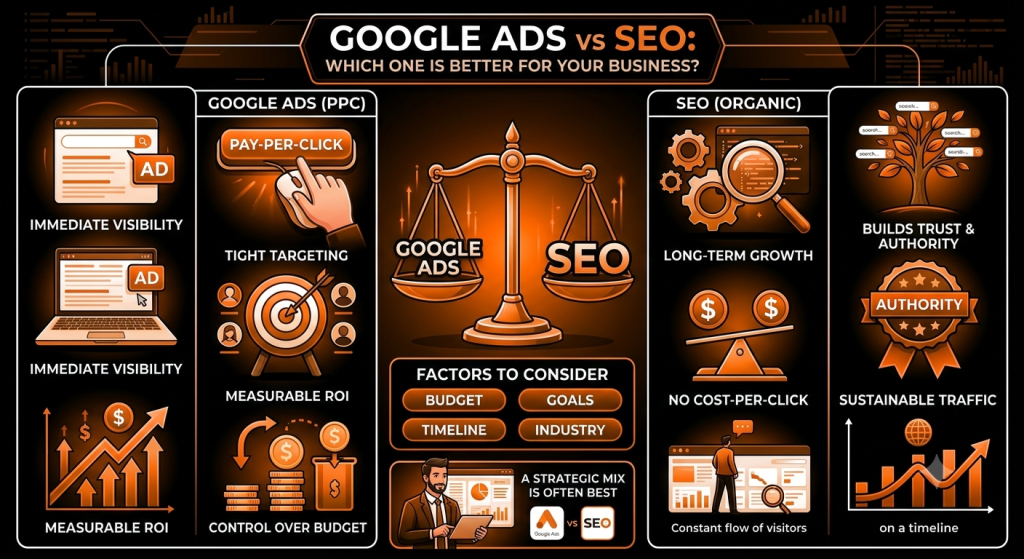
- Most business owners run into this decision sooner or later: put money into Google Ads for quick visibility, or invest time into SEO for organic growth that builds over months. Both promise to bring in customers through search, and both cost something — just in different currencies, time versus budget.
- The confusion is understandable. Agencies pitch SEO as the long game and Google Ads as instant results, but neither story is complete on its own. This article breaks down what SEO and Google Ads actually do, how they compare on speed, cost, and long-term value, and how to figure out which one — or whether both — makes sense for your business.
- Quick Answer: Google Ads can provide faster visibility and traffic once a campaign is running, while SEO generally takes longer but can build sustainable organic visibility over time. Neither is automatically better for every business — the right choice depends on your goals, budget, competition, and how quickly you need results. In many cases, businesses benefit from using both.
What Is SEO?
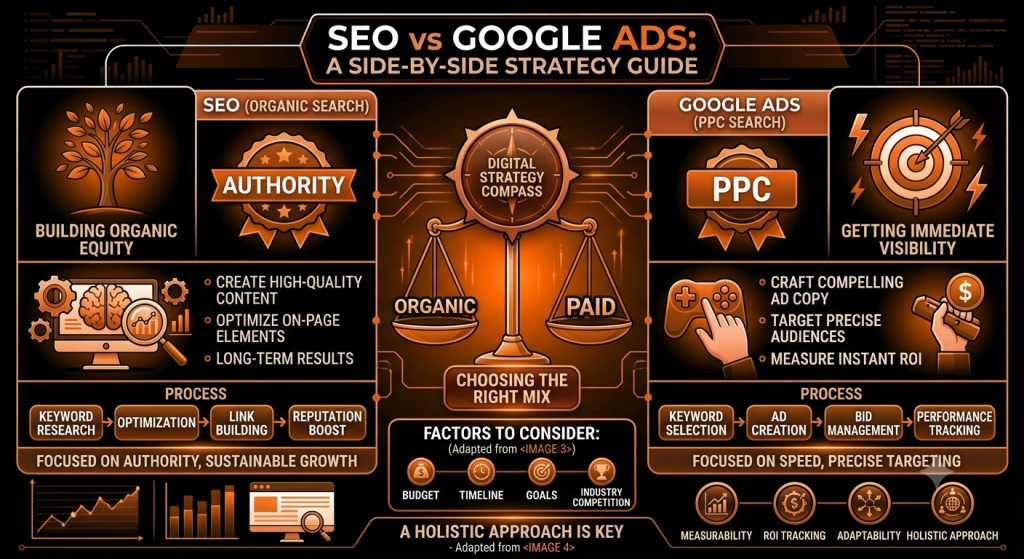
SEO, or search engine optimization, is the practice of improving a website so it shows up in organic (unpaid) search results. It covers on-page SEO — titles, headings, and content on your own pages — technical SEO, which covers things like site speed and crawlability, and off-page SEO, which mainly involves building credibility through other sites linking back to yours.
Search engines discover pages by crawling links, decide whether to index them, and then rank indexed pages based on relevance, content quality, site authority, and user experience. A simple example: a plumbing company that publishes a genuinely useful guide on “how to stop a leaking tap” and structures its site well has a real shot at showing up when someone nearby searches that exact problem.
What Are Google Ads?
Google Ads is Google’s paid advertising platform. Businesses bid on keywords so their ads appear above or alongside organic results when someone searches a relevant term. Advertisers typically set a budget, target specific keywords or audiences, write ad copy, and send clicks to a landing page built around a conversion goal — a call, a form, or a purchase.
Generally, businesses pay when someone interacts with the ad, such as clicking it, though exact billing details and available ad formats vary and can change over time — it’s worth checking Google’s own documentation for current specifics rather than relying on older information.
A simple example: a local electrician might run a campaign targeting “emergency electrician [city]” so their ad appears right when someone urgently needs help, rather than waiting to rank organically for that term.
Google Ads vs SEO: What's the Difference?
| Factor | SEO | Google Ads |
|---|---|---|
| Traffic type | Organic | Paid |
| Speed | Usually slower | Usually faster |
| Cost model | Investment in SEO, content, and technical work | Ongoing advertising spend |
| Long-term value | Can build lasting organic visibility | Traffic generally depends on active campaigns |
| Control | Less direct control over rankings | More control over targeting and budget |
| Visibility | Organic search results | Paid placements |
| Testing | Slower to test some changes | Faster campaign testing |
| Best suited for | Long-term growth | Faster traffic and campaigns |
None of these rows are absolute rules — a competitive industry can make SEO slow regardless of effort, and a well-optimized ad campaign can sometimes sustain results for a long time. The table is a general pattern, not a guarantee.
Which Gives Faster Results: SEO or Google Ads?
Google Ads generally produces visibility faster — once a campaign is approved and running, your ad can start appearing right away. SEO normally takes more time because rankings depend on many factors: your website’s current authority, content quality, technical health, and how competitive your industry is.
It’s worth being careful with the word “faster,” though. Faster traffic isn’t automatically better traffic — it only helps when your offer, landing page, targeting, and conversion process are strong enough to actually turn clicks into customers. Results also vary widely by website and industry, so there’s no guaranteed timeline for either approach.
Google Ads vs SEO: Which One Costs More?
Google Ads requires an ongoing advertising budget — you generally stop appearing once you stop paying. SEO involves a different kind of cost: strategy, content creation, technical improvements, and authority-building work, often supported by tools or outside expertise.
It helps to be clear about two common misconceptions: SEO doesn’t mean “free traffic” — real work and often real money go into it — and Google Ads doesn’t automatically mean “expensive traffic,” since costs depend heavily on your industry and competition. A niche, low-competition service might see reasonable ad costs, while a crowded market can push costs up considerably.
Which Is Better for Long-Term Growth?
SEO tends to offer stronger long-term value when a business consistently builds useful content, improves its website, and earns organic visibility over time — that visibility doesn’t disappear the moment you stop actively working on it, though it can decline without ongoing attention.
Google Ads remains genuinely valuable for different situations: immediate campaigns, product launches, seasonal offers, promotions, lead generation pushes, testing new offers, and capturing high-intent searches right when they happen. It’s less about one being “better long term” and more about which job each one is suited for.
SEO vs Google Ads: Which Has Better ROI?
ROI can’t be settled by simply declaring a winner — it depends on cost per lead, cost per acquisition, conversion rate, customer lifetime value, average order value, profit margin, traffic quality, campaign costs, SEO investment, and how long it takes to see results.
As a simple illustration: one business might spend steadily on Google Ads and see consistent, measurable leads from day one, while another invests the same amount into SEO over a year and ends up with lower ongoing costs per lead once rankings establish — but only after an initial period with little return. Neither outcome is universal; it depends entirely on the specific business, industry, and execution.
Benefits of SEO for Businesses
- Builds organic visibility that doesn’t disappear the moment spending stops
- Can support long-term traffic from pages that continue ranking well
- Helps attract people actively searching for exactly what you offer
- Builds website authority that can support future content and pages too
- Supports content marketing by giving useful content a place to be found
- Can generate ongoing traffic from strong, well-ranked pages
- Helps improve overall website quality, which benefits every visitor, not just search engines
- Can support brand credibility, since organic rankings are often seen as more trustworthy than ads
Limitations of SEO
- Takes real time — meaningful results rarely show up in days or weeks
- Rankings are genuinely competitive, especially in crowded industries
- Results are never guaranteed, no matter how much effort goes in
- Requires ongoing work, not a one-time project
- Search algorithms can change and affect existing rankings
- High-quality content is necessary, which takes real skill and effort to produce
- Technical problems on a site can quietly undercut otherwise solid SEO work
Benefits of Google Ads for Businesses
- Faster visibility — campaigns can start showing results quickly once live
- Intent-based targeting — reaching people actively searching for what you offer
- Budget control — you decide how much to spend and can adjust it any time
- Geographic targeting — useful for local and regional businesses
- Audience targeting — available options depend on campaign type and platform features
- Campaign flexibility — pausing, adjusting, or scaling is straightforward
- Measurable performance — detailed data on clicks, cost, and conversions
- Useful for testing offers — quickly learning what resonates before committing further
- Useful for lead generation and sales campaigns — especially with clear, time-sensitive goals
Limitations of Google Ads
- Requires ongoing advertising spend to keep producing results
- Competitive keywords can become costly, especially in crowded industries
- Poorly built campaigns can waste budget quickly
- Results depend heavily on targeting quality and the landing page behind the ad
- Traffic generally falls once campaigns stop running
- Requires ongoing monitoring and optimization to stay efficient

SEO or Google Ads: Which Is Better for Small Businesses?
SEO may be especially useful when:
- The business wants long-term growth rather than a quick spike
- The website can genuinely support useful, ongoing content
- The business operates in a local or fairly niche market
- Building organic visibility over time fits the business’s timeline
- There’s time available to invest before expecting strong results
Google Ads may be especially useful when:
- The business needs leads relatively quickly
- There’s a strong, clear commercial offer behind the campaign
- The business can sustain an ongoing advertising budget
- Customers actively search for the specific product or service
- The business wants detailed, measurable campaign data
Should a New Business Start With SEO or Google Ads?
New businesses often face a specific challenge: little to no existing website authority, which makes SEO slower at first, and limited data on what actually converts, which makes Google Ads riskier without some testing.
A practical starting point for many new businesses includes basic technical SEO, local SEO if relevant, genuinely useful website content, a small Google Ads budget for immediate visibility, conversion-focused landing pages, and proper tracking from day one so early decisions are based on real data rather than guesswork. Which combination makes sense still depends heavily on the specific business and industry.
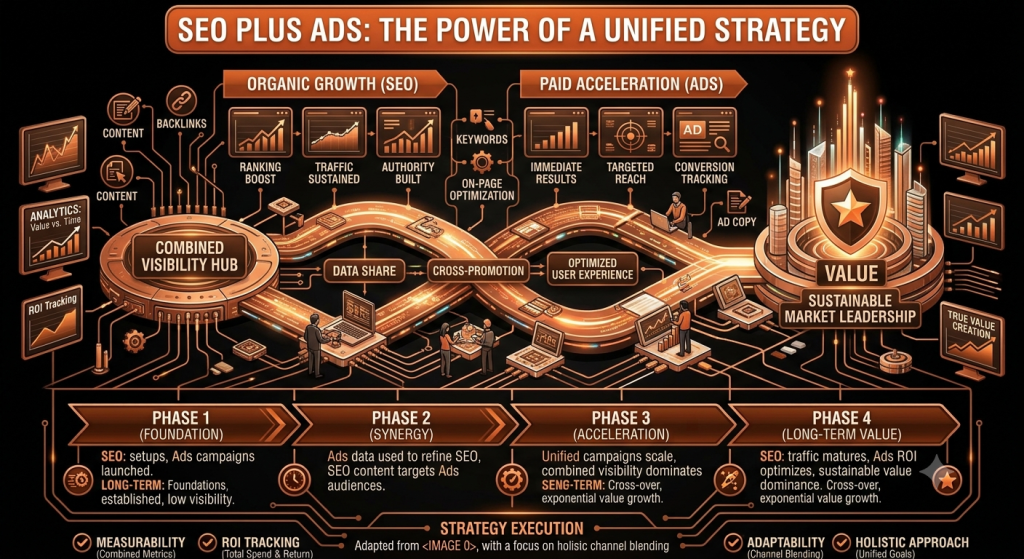
Can SEO and Google Ads Work Together?
They don’t have to compete for the same budget or attention. A useful way to frame it: SEO builds long-term organic growth, while Google Ads provides faster paid visibility and testing.
Data from paid campaigns — which keywords actually convert, which messaging resonates — can inform your SEO content strategy, while SEO builds organic visibility that reduces reliance on ad spend over time. As a hypothetical example, a business might use Google Ads to quickly test which service pages generate the most enquiries, then prioritize SEO content around those same topics once the paid data confirms real demand.
How to Choose Between SEO and Google Ads ?
Choose SEO if:
- You want sustainable organic visibility over time
- You can invest real time and effort into content and site quality
- Your customers regularly search for the services you offer
- You want to build long-term website value, not just short-term traffic
Choose Google Ads if:
- You need traffic or leads relatively quickly
- You have a defined advertising budget you can commit to
- Your offer has strong, clear commercial intent
- You want to test ideas and campaigns quickly
Consider both if:
- You want immediate visibility alongside long-term growth
- Your budget realistically allows for both
- Search is an important channel for how customers find you
Example: A Local Digital Marketing Agency
The following is a hypothetical example meant to illustrate how SEO and Google Ads might work together — not a real case study or verified result.
A local digital marketing agency wants more leads. It could use Google Ads to target people actively searching for digital marketing services in its area, build dedicated landing pages for those campaigns, and track which searches actually convert into enquiries. At the same time, it could build SEO content around the specific questions and services those same searchers care about, and improve its local search visibility through a complete Google Business Profile and consistent business information.
Over time, the agency could track leads and conversions from both channels, gradually shifting more weight toward organic traffic as its SEO content builds authority, while keeping Google Ads active for immediate, measurable leads.
Common Mistakes Businesses Make With SEO and Google Ads
- Expecting instant SEO results — give it realistic time before judging whether it’s working.
- Running Google Ads without conversion tracking — you can’t optimize what you can’t measure.
- Choosing keywords without understanding search intent — traffic that doesn’t match intent rarely converts.
- Sending paid traffic to weak landing pages — undermining otherwise solid targeting.
- Focusing only on traffic instead of conversions — traffic alone doesn’t pay the bills.
- Stopping SEO too early — abandoning it right before compounding results would have kicked in.
- Spending on ads without testing campaigns — launching a single untested approach and hoping it performs.
- Treating SEO and Google Ads as completely separate strategies — missing the chance to let each inform the other.
Frequently Asked Questions
Is SEO better than Google Ads?
Not universally. SEO tends to offer stronger long-term value and doesn’t require ongoing ad spend to stay visible, but it takes longer to show results than Google Ads does.- Is Google Ads better than SEO?
Not universally either. Google Ads can produce faster, more controlled visibility, but that visibility generally depends on continuing to pay for it, unlike organic SEO rankings. - Which is cheaper, SEO or Google Ads?
It depends on your industry and competition. SEO avoids ongoing ad spend but still involves real costs in time, content, and expertise, while Google Ads costs vary widely by keyword competitiveness. - Which gives faster results, SEO or Google Ads?
Google Ads generally produces visibility faster, often within days of a campaign going live. SEO typically takes longer because rankings depend on content quality, site authority, and competition. - Is SEO worth it for a small business?
For most small businesses that rely on search for customers, yes — especially over the long term. It requires patience and consistent effort, but it can reduce reliance on ongoing ad spend over time. - Should I use SEO and Google Ads together?
In many cases, yes. Google Ads can provide faster visibility and useful data on what converts, while SEO builds long-term organic presence — together they can support both immediate and lasting growth. - Which is better for a new business: SEO or Google Ads?
Many new businesses benefit from starting with a mix — basic SEO fundamentals for long-term growth, alongside a modest Google Ads budget for immediate visibility while SEO builds up.
Conclusion: SEO or Google Ads — Which One Should You Choose?
The core difference comes down to this: SEO builds organic visibility that can last, but takes time and consistent effort. Google Ads can deliver faster, more controlled traffic, but generally requires ongoing spend to keep it going. There’s no universal winner — the right choice depends on your goals, budget, timeline, industry, and audience.
SEO tends to make sense when you’re building for the long term and can invest the time it takes. Google Ads tends to make sense when you need results on a shorter timeline and have a budget to support it. For many businesses, using both strategically — letting paid data inform organic priorities, and organic content reduce long-term ad dependency — ends up being the strongest approach. Take a look at your current marketing mix and see where the gaps actually are before deciding where to invest next.