
How Social Media Can Help a Small Business Grow
You can have the best product on the street or the best service in town, and still watch the phone stay quiet. Not because the business isn’t good enough, but because not enough people know it exists yet. That is the exact gap social media is built to close.
This guide walks through how social media actually supports small business growth — not by promising overnight success, but by explaining, step by step, how visibility turns into trust, trust turns into leads, and leads turn into paying customers. You will learn which platforms make sense for your business, what to post, how often, how to tell if it’s working, and the mistakes that quietly waste the most time and money.
What Is Social Media Marketing for Small Businesses?
Social media marketing is the practice of using platforms like Instagram, Facebook, or LinkedIn with a purpose — to build an audience, share useful content, talk to customers, and guide people toward a purchase. It is different from simply having a business page that sits there with a logo and an address.
A business account without a plan is just a digital signboard. Social media marketing includes:
- Creating content that is genuinely useful or interesting to your audience
- Building an audience of people who actually fit your target customer
- Engaging with comments, questions, and messages
- Promoting products or services without turning every post into an advertisement
- Generating leads through offers, forms, or direct conversations
- Building brand recognition so people remember you when they are ready to buy
- Measuring what is working and adjusting the approach
For example, a neighbourhood salon that only posts price lists is running an account, not a strategy. A salon that shares quick styling tips, shows real client transformations, and answers hair-care questions in the comments is doing social media marketing — the content has a job to do.
Why Social Media Matters for Small Businesses
Social media is valuable for smaller businesses because it lowers the cost of reaching people who don’t yet know you. A local bakery does not need a billboard budget to be seen by families within a five-kilometre radius. It needs consistent, relevant content and a bit of patience.
The realistic opportunities include:
- Increased visibility among people who are searching for what you offer
- Brand awareness that builds up over repeated exposure
- Direct communication with customers through comments and messages
- Trust building through transparency and consistency
- Community building around shared interests or local identity
- Website traffic from links in posts, bios, and stories
- Lead generation through forms, DMs, and offers
- Product discovery for people who weren’t actively looking
- Better customer retention through ongoing engagement
- A more competitive position against bigger, better-funded businesses
It’s worth being honest about the limits too. Social media does not guarantee growth on its own. Results depend on your industry, your audience, your consistency, and how well your offer actually matches what people want. It is a channel, not a magic switch.
How Social Media Can Help a Small Business Grow
This is the core of the guide — the specific ways social media activity connects to real business outcomes.
1. Increase Brand Awareness
Every time someone sees your logo, colours, or tone of voice, you become slightly more familiar. Familiarity is what makes a stranger comfortable enough to click, message, or walk in. A home-service business that posts short before-and-after clips every week, using the same visual style each time, becomes recognisable in a way a one-off ad never could.
2. Reach the Right Audience
Reaching a large number of random people is far less valuable than reaching a smaller number of the right people. Targeting can be based on:
- Location
- Age
- Interests
- Needs and pain points
- Buying behaviour
- Industry
- Specific problems your product solves
A thousand followers who are genuinely interested in your city and your niche will bring more enquiries than fifty thousand followers who have no reason to buy from you.
3. Build Trust and Credibility
People buy more comfortably from businesses they recognise and understand. Social media lets you show expertise, real customer experiences, behind-the-scenes work, product knowledge, the personality of your team, and honest results. A tradesperson who posts short clips explaining why a repair was done a certain way builds more credibility than one who only posts a phone number.
4. Generate Leads and Enquiries
Social media contributes to lead generation through direct messages, contact buttons, lead forms, links to your website, offers, clear calls to action, educational content, and landing pages. It’s important to separate engagement from a qualified lead — a like is not a lead. A person who messages to ask about pricing or fills out a form is.
5. Drive Traffic to Your Website
Posts, stories, and bios can point people toward blog posts, service pages, product pages, landing pages, guides, videos, and offers. Traffic is only valuable when the page it lands on is relevant and genuinely useful — sending someone to a generic homepage from a specific offer post usually wastes the click.
6. Build Strong Customer Relationships
Social media is a two-way channel. Comments, direct messages, questions, feedback, quick customer support, polls, and community discussions all give you a chance to respond like a real person. Responsiveness matters — a business that replies quickly and personally stands out simply because most don’t.
7. Showcase Products and Services
There are many ways to present what you offer without turning every post into a sales pitch: product demonstrations, tutorials, honest before-and-after examples where relevant, feature and benefit breakdowns, customer stories, and FAQs. A mix of educational and promotional content keeps an audience engaged instead of tuning out.
8. Create a Loyal Community
An audience watches; a community participates. Conversations, user-generated content, customer appreciation posts, questions, polls, and small local events turn passive followers into people who feel some ownership over your brand. Communities support long-term relationships that outlast any single promotion.
9. Learn What Customers Actually Want
Comments, questions, poll responses, engagement patterns, frequently asked questions, and content performance all reveal what your audience actually cares about. That feedback can improve your products, your services, and your future marketing — often more reliably than a formal survey.
10. Compete With Larger Businesses
Social media does not automatically make a small business equal to a large corporation, but it does open a few realistic advantages: faster and more personal communication, niche positioning, local relevance, authentic storytelling, and closer customer relationships. A small, specialised business that shows up consistently and personally can out-compete a larger, more impersonal one in its own niche.
Which Social Media Platforms Are Best for Small Businesses?
You do not need to be on every platform. It’s better to pick one or two that match where your audience already spends time.
| Platform | Best For | Suitable Content | Example Business |
|---|---|---|---|
| Local reach, community groups, older audiences | Updates, offers, events, community posts | Local restaurant or service provider | |
| Visual products, lifestyle, younger audiences | Photos, reels, stories, behind-the-scenes | Salon, boutique, bakery | |
| B2B, professional services, hiring | Insights, case studies, company updates | Consulting or agency | |
| YouTube | In-depth, evergreen content | Tutorials, demos, explainers | Home-service or educational business |
| TikTok | Short-form video, discovery, younger audiences | Quick tips, trends, product demos | Retail or food business |
| Visual inspiration, planning-stage buyers | Idea boards, infographics, product images | Interior design, fashion, food | |
| X (Twitter) | Real-time updates, industry conversation | Quick updates, customer support | Tech or news-driven business |
Platform choice should depend on your target audience, your industry, what content you can realistically create, your business goals, and the time or budget you actually have available.
How to Choose the Right Social Media Platform
A simple decision-making framework can save months of wasted effort. Ask yourself:
- Where does my target audience spend time?
- What type of content can my business create consistently?
- What is my primary goal — awareness, leads, or sales?
- Do I need local reach, B2B visibility, product discovery, or community engagement?
- How much time and budget can I realistically invest each week?
One or two platforms managed properly will always outperform six accounts that get updated once a month.
What Should a Small Business Post on Social Media?
Content works best when it serves a clear purpose rather than filling a calendar. A practical mix includes:
- Educational posts and quick tips
- Tutorials and how-to content
- Product demonstrations
- Answers to frequently asked questions
- Customer stories and testimonials
- Behind-the-scenes content
- Industry insights
- Short-form videos
- Simple, clear images
- Polls and questions
- Company updates
- Offers and promotions
- Seasonal or local content
- User-generated content from happy customers
Each type has a job: education builds trust, behind-the-scenes builds familiarity, testimonials build credibility, and offers move people toward a decision.
Create a Simple Social Media Content Strategy
A workable strategy does not need to be complicated. Eight steps are enough to get started properly:
- Define your goal — awareness, engagement, leads, sales, or retention
- Define your target audience clearly
- Choose one or two suitable platforms
- Create three to five content pillars (recurring themes you’ll post around)
- Build a realistic posting schedule you can actually maintain
- Engage with your audience daily, not just post and disappear
- Measure performance against your original goal
- Improve the plan based on what the numbers actually show
How Often Should a Small Business Post on Social Media?
There is no single number that works for every business. What matters more than frequency is consistency, content quality, audience expectations, and the norms of the platform you’re using.
A business that posts three good, useful posts a week for a year will almost always outperform one that posts daily for three weeks and then stops. Choose a frequency you can sustain, not one that looks impressive on paper.
Organic Social Media vs Paid Social Media
| Organic Social Media | Paid Social Media |
|---|---|
| Unpaid content | Requires an advertising budget |
| Builds an audience gradually over time | Can expand reach quickly |
| Focuses on engagement and community | Offers strong, precise targeting |
| Supports long-term relationship building | Works well for specific, time-bound campaigns |
The two approaches work best together — organic content builds the trust that makes paid ads convert better, and paid ads can accelerate reach for content that’s already proven itself organically. Paid advertising does not guarantee immediate sales; it needs a clear goal and a relevant landing page to work well.
How Social Media Advertising Can Help Small Businesses
For businesses ready to invest a small budget, paid social advertising adds precision that organic reach alone can’t match. The key components are:
- Audience targeting based on demographics, interests, or behaviour
- Budget control so spending stays predictable
- Ad creatives — the images, videos, and copy people actually see
- Landing pages that match what the ad promised
- Clear calls to action
- Retargeting people who already showed interest
- Conversion tracking to see what the spend actually produced
Before spending anything, have a clear objective in mind — more enquiries, more sales, more sign-ups — so you can judge whether the campaign actually worked.
How to Turn Social Media Followers Into Customers
Followers alone do not equal revenue. The realistic path looks like this:
Content leads to interest, interest leads to trust, trust leads to action, action leads to a lead, and a lead becomes a customer.
To support that journey, make sure you have a strong profile, a clear bio, a clear offer, genuinely useful content, visible social proof, a clear call to action, an easy way to get in touch, relevant landing pages, and a fast response time when someone does reach out.
Common Social Media Mistakes Small Businesses Should Avoid
- Trying to be active on every platform at once — better approach: pick one or two and manage them well
- Posting without any strategy — better approach: define a goal before you post
- Posting only promotional content — better approach: mix in education and stories
- Ignoring comments and messages — better approach: reply promptly and personally
- Buying followers — better approach: grow a smaller, real, engaged audience
- Using fake engagement — better approach: focus on genuine interaction
- Copying competitors directly — better approach: build your own voice and pillars
- Inconsistent branding across posts — better approach: keep colours, tone, and style consistent
- Ignoring analytics — better approach: review performance monthly
- Expecting instant sales — better approach: plan for a gradual build-up of trust
- Focusing only on follower count — better approach: track engagement and leads instead
- Posting low-quality content — better approach: prioritise clarity over frequency
- Not understanding the target audience — better approach: research before creating content
- Using the wrong platform for the business type — better approach: match the platform to where your audience actually is
How to Grow on Social Media With a Small Budget
Growth doesn’t require a large budget if effort is placed correctly. Prioritise:
- Organic content built around your content pillars
- Repurposing one piece of content into multiple formats
- Encouraging customer-generated content
- Educational posts that answer real questions
- Short videos, which tend to get better organic reach
- Local, community-relevant content
- Genuine engagement with your existing audience
- Small, selective paid campaigns only once you know what content performs
Avoid spreading a small budget across too many platforms or boosting posts without a clear goal — both are common ways small budgets get wasted.
How to Measure Social Media Marketing Success
The right metrics depend on your objective, but the most useful ones generally include:
- Reach and impressions
- Engagement and engagement rate
- Website clicks
- Profile visits
- Leads and messages generated
- Conversion rate
- Sales directly attributable to social media
- Cost per lead
- Return on ad spend, where paid campaigns are involved
Follower count is the easiest number to see, but it is rarely the most important one. A smaller, engaged audience that actually converts is worth more than a large, inactive one.
A Simple 30-Day Social Media Plan for a Small Business
Week 1 — Setup and Strategy
Define your goal and audience, tidy up your profile and bio, choose one or two platforms, and outline three to five content pillars.
Week 2 — Content and Engagement
Start posting consistently around your pillars, reply to every comment and message, and begin noting which posts get the most engagement.
Week 3 — Community and Promotion
Introduce polls or questions, share a customer story or testimonial, and test one small offer or promotion.
Week 4 — Measurement and Improvement
Review reach, engagement, and any leads generated, identify what worked best, and adjust your content pillars and schedule for the following month.
Realistic Example of Social Media Helping a Small Business
Consider a fictional local bakery.
Before: low awareness outside the immediate street, inconsistent posting, limited engagement, and no clear strategy.
Strategy: the owner defined a local audience, chose Instagram and Facebook, built content pillars around daily specials, behind-the-scenes baking, and customer favourites, posted consistently, replied to every comment, and ran a couple of small, targeted promotions.
Potential outcome: better visibility in the local area, more enquiries through direct messages, more visits to the online ordering page, stronger relationships with regular customers, and improved recognition of the bakery’s name and branding.
Results like these vary depending on industry, audience, competition, and how consistently the strategy is executed — there is no fixed number that applies to every business.
How Social Media Fits Into a Larger Digital Marketing Strategy
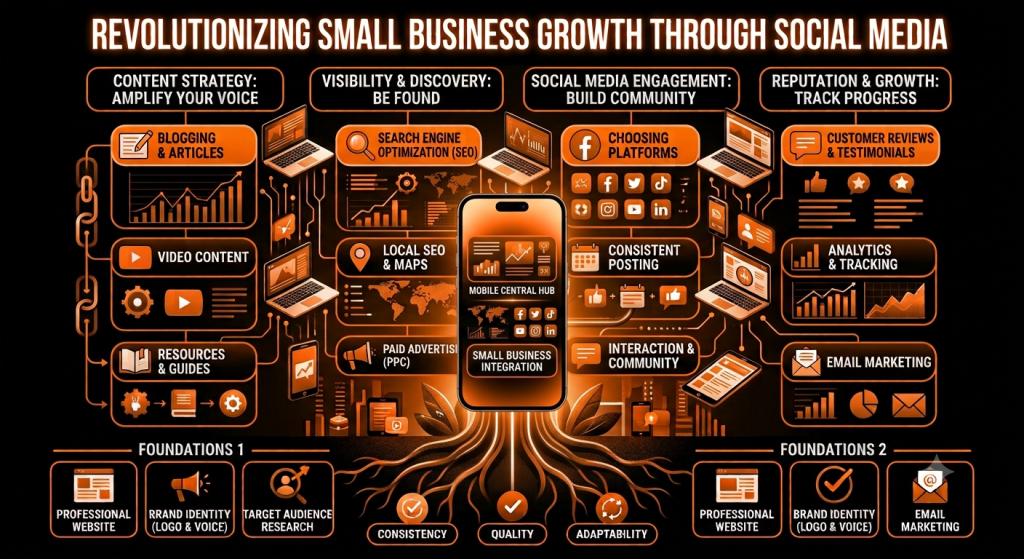
Social media rarely works best in isolation. It complements SEO, local SEO, content marketing, email marketing, website development, paid search advertising, and online reputation management.
A simple way to see the relationship: SEO supports discovery, social media supports engagement, content supports education, email supports retention, paid ads support targeted reach, and the website supports final conversion. Each channel does a different job, and together they cover the full customer journey.
Frequently Asked Questions About Social Media for Small Businesses
How can social media help a small business grow?
It increases visibility, builds trust through consistent content, and creates a direct channel for leads and customer relationships. Over time, this visibility and trust translate into enquiries and sales, provided the content is relevant and consistent.
Is social media marketing worth it for a small business?
For most small businesses, yes — the cost of entry is low compared to traditional advertising. Its value depends on choosing the right platform, posting relevant content, and being patient enough to build an audience.
Which social media platform is best for small businesses?
There is no single best platform for every business. The right choice depends on where your target audience spends time, your industry, and the type of content you can create consistently.
How often should a small business post?
Consistency matters more than a specific number. A realistic, sustainable schedule of a few quality posts each week generally works better than daily posting that quickly burns out.
How can social media generate customers?
Through a combination of visibility, trust-building content, clear calls to action, and easy ways to get in touch, such as direct messages, contact buttons, or lead forms.
Do small businesses need paid social media advertising?
Not always. Many small businesses grow steadily through organic content alone. Paid advertising becomes useful when you want faster reach or more precise targeting for a specific goal.
How much does social media marketing cost?
Costs vary widely depending on whether you manage it yourself, hire help, or run paid ads. Organic content mainly costs time; paid campaigns can start with a small, controlled daily budget.
How long does it take to see results from social media?
Meaningful results usually take a few months of consistent posting and engagement. Trust and audience-building take time, and results vary by industry and competition.
How can I increase social media engagement?
Post content that invites a response, such as questions and polls, reply promptly to comments and messages, and keep content genuinely useful rather than purely promotional.
How many social media platforms should a small business use?
Usually one or two, chosen carefully, work better than many platforms managed inconsistently.
Can social media help local businesses?
Yes. Location-based targeting, local hashtags, and community-focused content can help local businesses reach nearby customers effectively.
How do I measure social media marketing success?
Track metrics that match your goal, such as reach, engagement rate, website clicks, leads generated, and conversion rate, rather than focusing only on follower count.
Conclusion
Social media is not simply about collecting followers. It is about reaching the right people, building trust, creating meaningful relationships, and guiding interested people toward becoming customers.
A small business does not need to be everywhere. It needs to choose the right platforms, understand its audience, create genuinely useful content, engage consistently, measure results honestly, and improve over time.
If your current social media presence feels scattered, this is a good moment to review it — pick one platform, define a simple content plan, and commit to showing up consistently for the next thirty days. Pairing that effort with the rest of your digital marketing, from SEO to email, will help each channel support the others.