
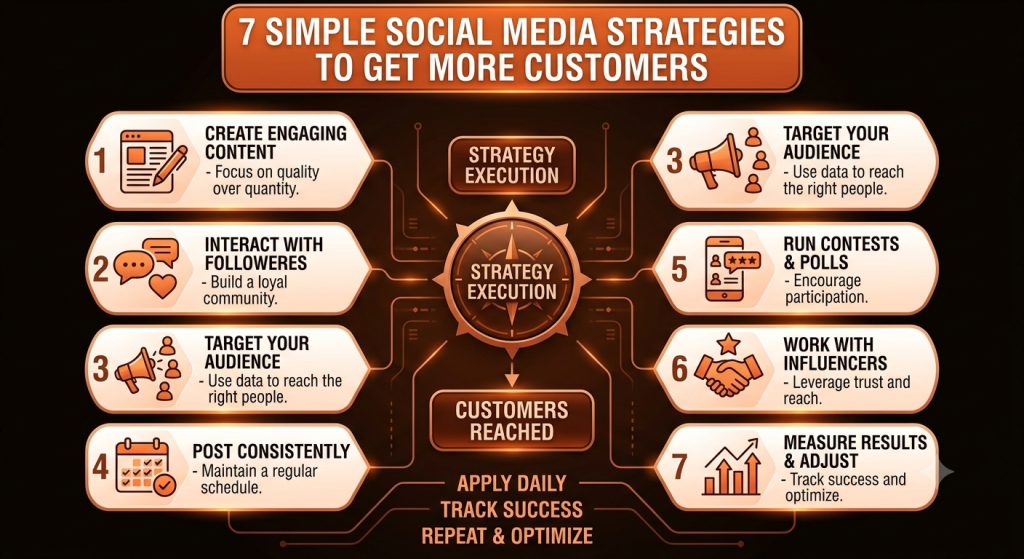
7 Simple Social Media Strategies to Get More Customers
- Plenty of businesses post on social media regularly and still don’t see many new customers coming from it. Having an account isn’t the same as having a strategy. Posting for the sake of posting can keep a page active without ever turning a single follower into a paying customer.
- The good news is that fixing this doesn’t require a big budget, a large team, or fancy tools. It usually comes down to a handful of practical habits, done consistently. This article walks through seven of them — simple enough to start this week, whether you’re running a local shop, a service business, or something online.
- Quick Answer: Social media helps a business get more customers when it’s used with a clear target audience, useful content, real engagement, and a clear next step for people to take. Posting alone rarely works — knowing who you’re talking to, what problem you’re solving, and what action you want them to take makes the real difference.
1. Know Exactly Who You Want to Reach
Before worrying about what to post, get specific about who you’re posting for. “Everyone” isn’t an audience — it’s the reason a lot of content falls flat. Think about the actual problems your ideal customer has, what they’re interested in, and how they tend to make buying decisions.
A simple way to do this is to sketch out a basic customer persona: their rough age range, where they live or work, what they’re trying to solve, and what might make them hesitate to buy. A plumber targeting homeowners with older properties writes very different posts than one targeting new-build developers — even though the service is the same.
2. Create Content That Solves Real Customer Problems
The posts that tend to earn attention are the ones that actually help someone — educational content, quick tips, short tutorials, FAQs, and before-and-after examples where it makes sense.
A bakery might share how to keep a cake fresh for longer. A repair shop might post the three warning signs that mean a customer should call before a small issue becomes an expensive one. This kind of content builds trust before anyone’s even considered buying, because it shows you actually know your field.
3. Use Short-Form Videos to Increase Reach
Reels and other short videos tend to reach more new people than static posts, partly because platforms actively push them to wider audiences. They don’t need to be polished — a quick demonstration, a behind-the-scenes clip, or a 30-second explainer often performs better than a heavily produced ad.
A salon might film a 15-second styling transformation. A consultant might record a quick tip answering a question clients ask often. Either way, video gives people a faster, more human way to get a feel for your business than a photo caption can.
4. Build Trust Through Real Engagement
Replying to comments, answering messages, and responding to questions matters more than it might seem. It’s easy to treat engagement as a numbers game — chasing likes and views — but the conversations happening in your comments and inbox are often where trust is actually built.
Someone who asks a question in your comments and gets a genuine, helpful reply is far more likely to remember your business than someone who just scrolled past a post. Showing up as a real person behind the account, not just a content feed, makes a difference.
5. Add Strong and Clear Calls to Action
A call to action, or CTA, simply tells someone what to do next — and without one, even a great post can go nowhere. People rarely take the initiative to figure out how to contact you on their own; they need to be told.
Effective CTAs are specific and easy to act on: “Send us a message to book,” “Visit the link to see pricing,” “Comment ‘INFO’ and we’ll send details,” “Call today for a free quote.” A clear CTA is often the single missing piece between a post that gets likes and one that actually brings in an enquiry.
6. Use Social Proof to Build Confidence
People hesitate before buying from a business they don’t know much about, and social proof reduces that hesitation. Customer reviews, testimonials, short case studies, user-generated content, and real results all show that other people have already trusted you and had a good outcome.
A short video of a happy customer, a screenshot of a glowing review, or a quick before-and-after photo does more to reassure a potential customer than almost any amount of self-promotion.
7. Track Results and Improve Your Strategy
Reach, engagement, clicks, messages, leads, website visits, and actual conversions all tell you something different about what’s working. Checking which posts perform well — and which don’t — lets you do more of what actually brings in customers instead of guessing.
It’s worth focusing on outcomes that matter to the business, not just vanity numbers. A post with fewer likes but three genuine enquiries is doing more for your business than one with hundreds of likes and zero messages.
A Simple Social Media Action Plan for Your Business
You don’t need to apply all seven strategies at once. Here’s a realistic way to start over a week:
Day 1: Write a short description of your ideal customer — their problem, their interests, and what might make them hesitate.
Day 2: Plan three pieces of genuinely useful content based on questions your customers actually ask.
Day 3: Film one short, simple video — a tip, a demo, or a behind-the-scenes clip.
Day 4: Reply to every comment and message you’ve received in the last week, even old ones.
Day 5: Review your last five posts and add a clear CTA to any that don’t have one.
Day 6: Collect one review, testimonial, or piece of customer feedback and share it.
Day 7: Check your basic numbers — which post got the most engagement or messages — and plan next week around what worked.
Common Social Media Mistakes That Can Stop You From Getting Customers
- Posting without knowing the target audience — content that isn’t written for anyone in particular tends to connect with no one in particular.
- Focusing only on selling — a feed full of offers with no real value in between tends to get tuned out.
- Ignoring comments and messages — unanswered questions are missed opportunities, not just bad manners.
- Posting inconsistently — a burst of activity followed by silence makes it hard to build any real momentum.
- Using weak CTAs — or no CTA at all, leaving people unsure what to do next.
- Chasing followers instead of customers — a large but disengaged following rarely translates into sales.
- Not tracking results — without checking what’s working, it’s easy to keep repeating the same ineffective approach.
Should You Use Organic or Paid Social Media Marketing?
Organic social media — regular, unpaid posting and engagement — builds trust and relationships over time, and it’s a solid starting point for most small businesses, especially with limited budget. Paid social media advertising can speed things up by putting your content in front of people who don’t already follow you, which is useful for promotions, launches, or when you need faster results.
Neither approach guarantees results on its own. Many businesses get the most value from combining the two: using organic content to figure out what resonates, then putting a small budget behind the posts and offers that are already working.
Frequently Asked Questions
- How can social media help a business get more customers?
It helps by putting your business in front of the right people, building trust through useful content and genuine engagement, and giving people a clear next step to take, such as messaging you or visiting your website. - What is the best social media strategy for small businesses?
There’s no single best strategy, but knowing your target audience and posting genuinely useful content consistently tends to matter more than any specific trick or platform feature. - How often should a business post on social media?
Consistency matters more than a specific number. Posting a realistic amount you can sustain — even a few times a week — tends to work better than posting daily for two weeks and then stopping. - Can social media generate real leads?
Yes, when posts include a clear call to action and the business responds promptly to messages and comments. Leads usually come from a combination of useful content and an easy way to make contact. - How do I turn social media followers into customers?
By building trust through useful content and real engagement, showing social proof like reviews, and giving followers a clear, specific action to take, such as messaging you or booking a call. - Should small businesses use paid social media ads?
It can help, especially for promotions or reaching people beyond your current followers, but it works best alongside organic content rather than as a replacement for it. - Which social media platform is best for getting customers?
It depends on where your target audience actually spends time and what kind of content you can create consistently — there’s no universal answer that fits every business.
Conclusion
- Getting more customers from social media usually comes down to seven simple habits: knowing your audience, creating genuinely useful content, using short-form video, engaging like a real person, adding clear calls to action, showing social proof, and tracking what actually works.
- You don’t need to do all of this perfectly from day one. Pick one or two strategies, apply them consistently, and build from there. Social media works best when it supports your actual business goals — not when it’s treated as a separate project disconnected from getting real customers through the door.