
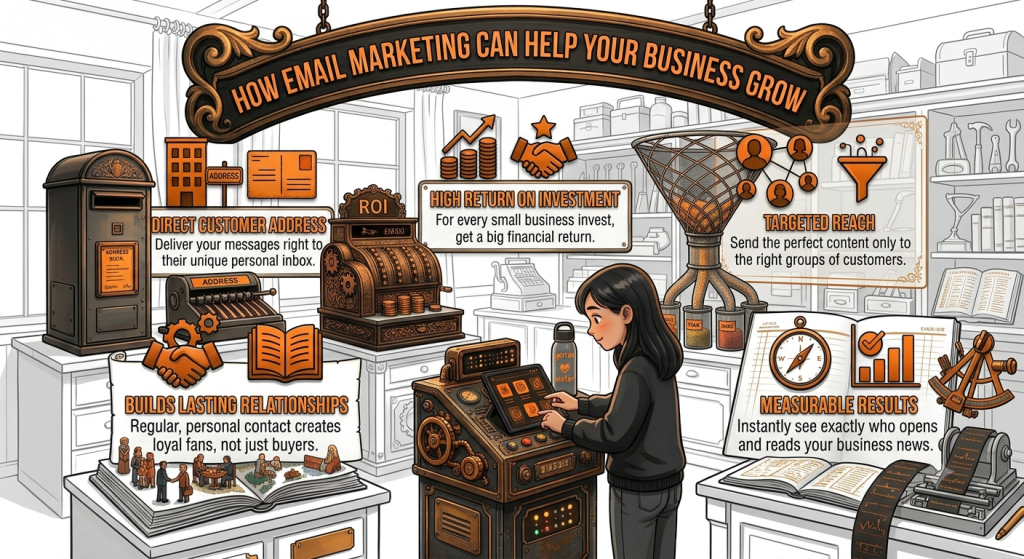
How Email Marketing Can Help Your Business Grow
Every business owner is looking for practical ways to grow, without burning through the whole marketing budget on things that may or may not work. Email marketing is one of those channels that quietly keeps doing its job in the background, long after the initial excitement of a new social media platform fades.
It is easy to think of email as just another way to send discounts. Done well, it is much more than that. It helps you stay in touch with people who are interested in what you do, guide them toward a decision, and keep existing customers coming back. This article looks at how email marketing can help your business grow, from the first subscriber to a long-term customer relationship.
Quick Answer: How Can Email Marketing Help Your Business Grow?
Email marketing helps a business grow by giving it a direct way to talk to people who are already interested. It can nurture leads with useful information, promote relevant products or services, build trust over time, encourage repeat purchases and keep your audience engaged between visits to your website or store. Used consistently, it supports both new sales and long-term customer relationships.
What Is Email Marketing?
Email marketing means sending emails to people who have agreed to hear from your business, such as newsletters, updates, tips or offers. You can send to website subscribers, existing customers, people who downloaded a resource or anyone who signed up through a form.
Permission and relevance matter here. Email marketing is not about blasting a list of strangers with adverts. It works because the people on your list chose to be there, and it stays useful only if what you send actually matters to them. Example: a bakery sends a short weekly email about new items and weekend specials to customers who signed up in-store. That is email marketing, nothing more complicated than that.
Why Email Marketing Can Support Business Growth
Growth usually comes from a mix of these things, and email can support all of them:
- Attracting leads through a useful sign-up offer
- Nurturing prospects who are not ready to buy yet
- Building trust with helpful, honest communication
- Generating sales through relevant offers
- Retaining customers so they do not forget about you
- Encouraging repeat purchases from people who already trust you
- Promoting new products or services to an audience that already knows you
- Sharing useful information that keeps you top of mind
- Staying connected without relying only on social media reach
Email Marketing Helps You Build Your Own Audience
An email list is a group of people who chose to hear from you, usually through a website sign-up form, a lead magnet, a newsletter, a free resource, a consultation request or a product update they opted into.
It is worth saying clearly: you do not fully “own” this audience in an absolute sense, since you still rely on email providers, inboxes and applicable rules to reach people. But compared with a social media following, an email list gives you a much more direct line of communication. It is better to build a smaller list of genuinely interested people than to collect thousands of addresses from people who will never open your emails.
Email Marketing Can Generate Leads
A simple lead-generation path looks like this: Website Visitor → Useful Offer → Email Signup → Nurturing → Sales Conversation → Customer.
The offer, often called a lead magnet, is what convinces someone to hand over their email. It should solve a real, specific problem. Good examples include a checklist, a guide, a template, a free consultation, an educational resource, a webinar, or a fair discount where it genuinely makes sense. A vague “subscribe to our newsletter” rarely convinces anyone.
Email Marketing Can Help Increase Sales
Email supports sales without every message needing to be a hard sell. Useful content includes product announcements, service promotions, special offers, product education, case studies, customer stories, FAQs, follow-up emails and relevant recommendations.
There is a real difference between helpful selling and aggressive selling. Helpful selling explains how something solves a problem the reader already has. Aggressive selling pushes urgency and pressure regardless of whether the reader is ready. Email marketing cannot promise sales. What it can do is put a clear, honest offer in front of people who are already somewhat interested, which tends to work better than cold outreach.
Email Helps Build Customer Trust
Most customers need some time before they buy, especially for anything beyond a small purchase. Trust builds through helpful tips, educational content, case studies, testimonials, customer stories, FAQs, useful resources and communication that is transparent and consistent.
If every email from you is a sales pitch, people stop opening them. If most emails genuinely help, people keep reading, and they are far more open to your offers when you do make one.
Email Marketing Can Improve Customer Retention
Growth is not only about finding new customers. Keeping the ones you already have matters just as much, and email is well suited for that. Useful retention emails include:
- Welcome emails for new customers
- Thank-you emails after a purchase
- Onboarding emails that help people get started
- Product education and helpful tips
- Feedback requests
- New product or service updates
- Relevant repeat-purchase offers
- Simple, genuine loyalty communication
Staying useful and relevant, rather than going quiet until you want something, is what tends to keep the relationship alive.
Email Marketing Can Encourage Repeat Purchases
Once someone has bought from you, email can bring them back. An e-commerce store might send a restock alert or care tips for what they bought. A restaurant might announce a new menu item. A salon might remind clients it has been a while since their last visit. A service business, agency, coach or consultant might share a relevant update or a way to extend the work already done.
The key is relevance. A repeat-purchase email should connect to what the customer already experienced, not feel like a random blast.
Email Marketing Helps You Personalize Communication
Personalization uses what you already know to make an email more relevant: a name, a previous purchase, a past interest, a downloaded resource, the type of service someone wanted, or location when it genuinely matters.
Example: “Since you asked about our SEO service last month, here is a quick update on what has changed.” That is useful. Personalization should respect what people knowingly shared, and their expectations. Using details in a way that feels surprising or intrusive usually backfires.
Email Segmentation Can Improve Relevance
Segmentation means grouping your list so each group gets a more relevant email, instead of one message for everyone. Common segments include:
- New subscribers
- Existing customers
- Potential customers
- Past customers
- High-interest leads
- Subscribers interested in a specific service
- Subscribers who downloaded a specific resource
You do not need exact numbers to know this helps: a message that matches someone’s actual interest is simply more useful to them than a generic one.
Email Marketing Can Work With Other Marketing Channels
SEO
Search traffic can bring visitors to your website, where a sign-up form turns some of them into subscribers.
Content Marketing
Blogs and useful resources give people a reason to subscribe, since they already found something valuable.
Social Media
Social platforms can point people toward your email sign-up page, even though the platform itself controls how much reach you get.
Google Ads
Paid traffic can be sent to a landing page with a clear lead-generation offer, turning ad clicks into subscribers.
Website
Your website is usually the main place where a visitor becomes a subscriber, so a clear, simple sign-up form matters.
Email Marketing vs Social Media
| Email Marketing | Social Media |
| Direct communication with subscribers | Communication through a platform |
| Useful for nurturing | Useful for discovery and engagement |
| Supports personalized communication | Supports public or community interaction |
| Can support long-term customer relationships | Can support awareness and engagement |
Neither one is universally better. Social media is strong for discovery and engagement, while email is strong for nurturing and long-term relationships. Most businesses benefit from using both, for different purposes.
Email Marketing for Small Businesses
Small businesses often assume email marketing is only for big companies with large teams. In reality, it fits small operations well, since it helps you stay connected with customers, promote services, share offers, generate leads, nurture prospects, encourage repeat business and build a long-term subscriber base without a big budget.
- Local service businesses: seasonal reminders and booking prompts.
- Salons: rebooking reminders and new service announcements.
- Restaurants: menu updates and event nights.
- Clinics: appointment reminders and general wellness tips, kept accurate and careful with any claims.
- Coaches and consultants: practical lessons and invitations to a call.
- Digital marketing agencies: case studies and service-specific tips.
- E-commerce stores: restock alerts and product education.
None of this guarantees results. It gives you a consistent, low-cost way to stay in front of the people most likely to buy from you.
Types of Emails Businesses Can Use
Welcome Emails
Introduce your business and set expectations right after someone subscribes. Example: A short thank-you with what to expect and how often you will email.
Newsletter Emails
Keep subscribers updated with a regular mix of news and useful content. Example: A monthly roundup of tips, updates and one relevant offer.
Educational Emails
Teach something useful related to your product or service. Example: A how-to guide or a short explainer on a common problem.
Promotional Emails
Present a specific offer clearly and honestly. Example: A limited-time service package with a simple CTA.
Lead-Nurturing Emails
Move interested subscribers gradually closer to a decision. Example: A short series answering common questions before a purchase.
Follow-Up Emails
Reconnect with people who showed interest but did not act. Example: A gentle reminder after someone downloaded a guide but did not book a call.
Product or Service Update Emails
Inform existing customers about changes or new offerings. Example: An email about a new feature or added service.
Customer Retention Emails
Keep existing customers engaged after their first purchase. Example: A tip on getting more value from what they bought.
Re-engagement Emails
Reconnect with subscribers who have gone quiet. Example: A short “we miss you” message with something useful attached.
How to Create an Email Marketing Strategy
Step 1: Define your target audience
Know who you are writing to: their problems, goals and buying stage.
Step 2: Build your email list properly
Collect emails through sign-up forms and clear permission. Never buy a list.
Step 3: Create a valuable signup offer
Give people a real reason to subscribe, not just “join our newsletter.”
Step 4: Set up a welcome email
Introduce yourself and set expectations from the very first message.
Step 5: Create useful content
Mix helpful tips, stories and information with occasional offers.
Step 6: Segment your subscribers
Group your list so messages stay relevant to each group.
Step 7: Promote relevant offers
Match what you promote to what each segment actually needs.
Step 8: Follow up
Send a reminder or extra information to people who showed interest.
Step 9: Track performance
Watch opens, clicks, leads and sales connected to your emails.
Step 10: Improve based on data
Change one thing at a time and keep what works.
How Often Should You Send Emails?
There is no single perfect frequency that works for every business. It depends on your audience, business type, the kind of content you send, customer expectations, your marketing goals and how much quality content you can realistically produce.
Consistency and relevance generally matter more than volume. A weekly email that people look forward to beats a daily email people learn to ignore. Some businesses do well with a monthly newsletter plus occasional updates; others send weekly tips. Test a schedule you can sustain, and watch how subscribers respond rather than following a fixed formula.
What Makes an Email Effective?
- Clear subject line that sets the right expectation
- Useful content the reader actually cares about
- A message relevant to that subscriber
- Simple, plain writing
- A strong opening line that earns attention
- One clear main call-to-action
- Mobile-friendly formatting
- A relevant, honest offer
- Something that builds trust, like a tip or example
- An easy, obvious next step
Common Email Marketing Mistakes
- Buying email lists: build your own with permission instead.
- Sending irrelevant emails: segment so content matches interest.
- Only promotional content: mix in helpful, non-selling emails.
- Sending too often: watch unsubscribes and adjust.
- Sending too rarely: people forget who you are.
- No segmentation: start with a few simple groups.
- Weak CTAs: be specific about the next step.
- Poor subject lines: be clear and honest, not vague.
- Ignoring mobile users: check every email on a phone.
- No welcome email: set expectations from day one.
- No follow-up: a second message often gets more response than the first.
- Not measuring conversions: connect clicks to actual outcomes.
- Misleading subject lines: the content should match the promise.
- Unsupported claims: only state what you can back up.
- Ignoring unsubscribe requests: always honour them quickly.
How to Measure Email Marketing Results
- Open rate: a rough indicator of subject line and sender trust.
- Click-through rate: how many people engaged with your content.
- Conversion rate: how many completed the action you wanted.
- Unsubscribe rate: a signal about frequency or relevance.
- Bounce rate: how many emails could not be delivered.
- Leads generated: useful for lead-generation goals.
- Sales generated: useful for direct sales goals.
- Revenue attributed to email, where it can be measured accurately.
Match the metric to the goal. For lead generation, focus on leads and conversions. For sales, focus on purchases and revenue. For engagement, focus on clicks and meaningful replies. No single number tells the whole story on its own.
A Fictional Example: The Agency That Was Not Collecting Emails
It introduces a simple path: Content → Email Signup → Welcome Email → Helpful Emails → Segmentation → Service-Specific Offer → Follow-Up → Customer. It adds a sign-up form to its most popular blog posts, offering a short marketing checklist. New subscribers get a welcome email, followed by useful tips over the next couple of weeks. Based on which links people click, the agency groups them into SEO-interested and ads-interested segments, then sends a service-specific email to each, followed by a gentle follow-up for anyone who did not respond.
This does not guarantee a fixed number of new customers. But it turns visitors who would have left with nothing into a group the agency can keep talking to.
How to Turn Email Subscribers Into Customers
The basic journey looks like this: Subscriber → Trust → Engagement → Need → Solution → Offer → Action → Customer.
- Provide real value before asking for anything
- Understand what each subscriber actually needs
- Send information relevant to their situation
- Address common doubts or objections honestly
- Build trust through consistency and proof
- Make offers that clearly fit the reader
- Use a specific, clear call-to-action
- Follow up with people who show interest but do not act right away
Email Marketing and Customer Lifetime Value
The relationship does not end at the first purchase. Email can support the value a customer brings over time through repeat purchases, ongoing customer education, relevant cross-selling, upselling where it genuinely fits, loyalty communication and simply asking for feedback.
This is not about squeezing more money out of people. It is about staying useful enough that customers keep choosing you when they need something again.
Email Marketing, SEO, AEO and GEO
SEO
SEO can bring relevant visitors to your website through search. Once they are there, you can invite them to subscribe, turning a one-time visit into an ongoing relationship.
AEO
Answering customer questions clearly, both on your website and through email resources, creates a more useful information experience for readers and for answer-focused search tools.
GEO
Clear, trustworthy, well-structured information across your website and email content can help AI-powered search systems understand your business better. No one can promise rankings, AI citations or guaranteed visibility from this, but clarity rarely hurts.
Businesses build credibility, with readers and with search systems, by showing genuine experience and expertise: helpful educational content, accurate information, real examples, honest testimonials, case studies and transparent business details.
Responsible Email Marketing
Rules around marketing emails vary by country, so treat this as general good practice rather than legal advice, and check what applies to you and your subscribers.
- Get appropriate permission before sending marketing emails
- Respect subscriber preferences
- Make unsubscribing easy to find and use
- Avoid misleading subject lines
- Use honest sender information
- Protect subscriber data
- Avoid buying questionable email lists
- Follow applicable privacy and marketing requirements
Email Marketing Growth Checklist
- ☐ Do we know our target audience?
- ☐ Are we collecting emails with appropriate permission?
- ☐ Do we have a clear reason for people to subscribe?
- ☐ Do we have a welcome email?
- ☐ Are we providing useful content?
- ☐ Are emails relevant to subscribers?
- ☐ Are subscribers segmented?
- ☐ Are our offers clear?
- ☐ Are CTAs easy to understand?
- ☐ Are we following up?
- ☐ Are we tracking leads and sales?
- ☐ Are emails mobile-friendly?
- ☐ Are we respecting unsubscribe requests?
- ☐ Are we improving the strategy based on data?
Frequently Asked Questions
How can email marketing help my business grow?
It lets you stay in touch with interested people, nurture them with useful content, promote relevant offers and keep existing customers engaged, which supports both new sales and repeat business over time.
Is email marketing still effective for businesses?
For many businesses, yes. It gives direct access to subscribers rather than depending on a platform’s algorithm, and it can support lead generation, sales and retention when used consistently and honestly.
How does email marketing generate leads?
A useful offer, like a checklist or guide, encourages website visitors to subscribe. Nurturing emails then build trust and move interested subscribers toward a sales conversation.
Can email marketing increase sales?
It can support sales through relevant offers, product education, case studies and follow-ups, though results depend on your audience, offer and consistency. It works best combined with a good website and clear pricing.
Is email marketing useful for small businesses?
Yes. It is relatively low-cost and lets small businesses stay connected with customers, promote services and encourage repeat visits without a large marketing budget.
How often should a business send marketing emails?
There is no fixed rule. Many businesses do well with weekly or monthly emails. Choose a schedule you can keep consistently and adjust based on how subscribers respond.
What types of emails should a business send?
A mix works best: welcome emails, educational content, occasional promotions, follow-ups and retention emails for existing customers. Avoid sending only sales pitches.
How do I build an email list for my business?
Add a sign-up form to your website, offer something useful in return, and collect emails at checkout or in person with clear permission. Never buy a list.
How can I turn email subscribers into customers?
Build trust with helpful content, understand what each subscriber needs, send relevant offers with a clear next step, and follow up with people who show interest but do not act right away.
How do I measure email marketing success?
Track metrics tied to your goal, such as leads and conversions for lead generation, or purchases and revenue for sales. Open and click rates give useful context but rarely tell the whole story alone.
Final Thoughts
Email marketing will not fix every growth problem on its own, but it gives you something few other channels do: a direct, ongoing way to talk to people who already showed interest. Start with one sign-up form and one welcome email, keep showing up with something useful, and let the relationship build from there.