
How Much Should a Small Business Spend on Google Ads?
- “How much should I actually put toward Google Ads?” is one of the most common questions small business owners ask, and it’s also one of the hardest to answer honestly. Most people want a single number. The truth is there isn’t one — a dentist in a competitive city and a niche consultant with almost no direct competitors could reasonably spend very different amounts and both be making the right call.
- What actually determines a sensible budget is your industry, your competition, your keyword costs, how well your website converts, and what a new customer is actually worth to you. This article walks through how to think through those pieces so you can land on a starting budget that makes sense for your specific business, not someone else’s.
- Quick Answer: There’s no single correct Google Ads budget for every small business — it depends on your industry, location, keyword costs, competition, conversion rate, and what a customer is worth to you. Many businesses start with a modest, controlled test budget to gather real data, then adjust based on results. A specific number without knowing your numbers would just be a guess.
Is There a Minimum Budget for Google Ads?
Google Ads doesn’t require a large minimum spend to get a campaign running, but a technically possible tiny budget isn’t necessarily a practically useful one. If your daily budget is too small to generate more than a handful of clicks, you won’t gather enough data to actually tell whether your targeting, ads, or landing page are working.
A more useful way to think about a minimum is in terms of data, not just dollars: your budget needs to be large enough to generate a reasonable number of clicks over a few weeks, so you have something real to evaluate. Platform-specific rules and minimums can change, so it’s worth checking Google’s own current documentation rather than relying on older figures.
How Much Should You Spend on Google Ads Per Day?
A simple way to plan: daily budget × days in the month ≈ approximate monthly spend. That said, actual daily spending can vary somewhat day to day depending on campaign delivery and demand, so treat your daily budget as planning guidance rather than a fixed daily cap you’ll hit exactly every single day.
How Much Should You Spend on Google Ads Per Month?
Thinking monthly gives you more useful planning flexibility than obsessing over the daily number. Consider your monthly budget in terms of purpose: a smaller testing budget to learn what works, an ongoing lead-generation budget once you know your numbers, extra allocation for seasonal campaigns if relevant, and a scaling budget you add once a campaign has proven itself with real conversion data.
Example Google Ads Budgets for Small Businesses
These are illustrative examples meant to show a general shape, not guaranteed recommendations for your specific business — actual appropriate amounts depend heavily on your industry and location.
| Budget Level | General Idea | Suitable For |
|---|---|---|
| Small Test | Enough for a limited but meaningful data sample | Testing keywords and offers |
| Starter | A modest, sustained monthly commitment | Local or service businesses |
| Growth | Scaled up based on proven performance | Businesses with working campaigns |
| Higher Scale | Meaningfully larger, backed by strong data | Businesses with reliable conversion history |
Actual dollar or rupee amounts vary too much by industry and market to list responsibly here — check current CPC data for your specific keywords through Google’s own tools before settling on a number.
What Determines How Much You Need to Spend on Google Ads?
- Industry. Some industries simply have more advertisers competing for the same searches, which tends to push costs up.
- Keywords. Different keywords carry different levels of competition and commercial value — a broad, high-intent term usually costs more than a specific, long-tail one.
- Location. Costs and competition can vary noticeably between markets, even within the same country.
- Search volume. A larger addressable market with more search demand may require a larger budget just to capture a meaningful share of it.
- Competition. More advertisers bidding on valuable searches generally affects prices, similar to any auction.
- Conversion rate. A better-converting website turns the same traffic into more leads, effectively making your budget go further.
- Customer value. A business selling a high-value service can often justify a higher acquisition cost than a business with a low-ticket product.
- Campaign quality and relevance. Well-targeted campaigns with relevant ads and landing pages tend to get more out of the same spend than poorly matched ones.
What Is CPC and Why Does It Matter?
CPC stands for Cost Per Click — what you pay, on average, each time someone clicks your ad. CPC varies by keyword, industry, competition, and how relevant your ads and landing page are considered to be.
Cheap clicks aren’t automatically good, and expensive clicks aren’t automatically bad — what matters is the value of the customer behind the click. As a simple fictional example: a $2 click for a low-margin product might be too expensive, while a $15 click for a service worth thousands of dollars in customer value could be a genuine bargain.
How to Calculate a Google Ads Budget
A simple planning framework: required clicks = desired conversions ÷ conversion rate, and then estimated ad spend = required clicks × average CPC. These are planning formulas to help you estimate, not guarantees of what will actually happen.
As a purely illustrative fictional example: if a business wants 20 leads a month, expects a 5% conversion rate, that works out to roughly 400 clicks needed. At an example CPC of ₹50, that’s an estimated spend of around ₹20,000. These numbers are made up for illustration only — they are not a representation of actual average Google Ads costs for any real industry.
How Much Should a Local Business Spend on Google Ads?
Whether you’re a plumber, dentist, salon, restaurant, real estate agent, home service provider, local consultant, or digital marketing agency, the same underlying factors apply: your local competition, the value of an average customer, and how much genuine search demand exists in your area.
A dentist in a dense city with many competing practices will likely face higher costs per click than a specialist consultant in a smaller market with far less direct competition — even though both are “local businesses.”
Google Ads Budget for Service-Based Businesses
Service businesses generally care about calls, contact form submissions, and booked consultations. Budget planning should start from lead value: how much is a typical lead worth once you factor in your close rate and average customer value, and what acquisition cost still leaves you profitable?
As a fictional example, a consultant who closes 1 in 5 leads into a client worth $2,000 could reasonably justify paying more per lead than a business with a much lower close rate or customer value — the math simply supports it.
How Much Should an Ecommerce Business Spend on Google Ads?
Ecommerce budgeting can work a bit differently, since these businesses can often track purchases directly — revenue, average order value, conversion rate, return on ad spend (ROAS), and profit margin all become measurable inputs.
Revenue alone isn’t enough to judge success, though. A campaign generating strong sales but on thin margins might not actually be profitable once ad costs are factored in. There’s no universal ROAS target that applies across every store and margin structure — it depends on your specific numbers.
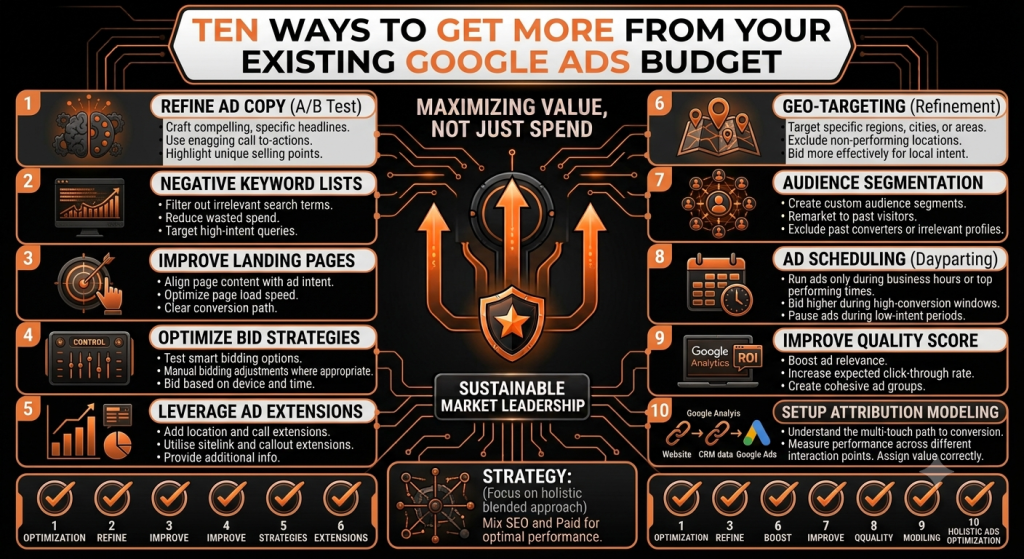
How to Make a Small Google Ads Budget Work Better
- Focus on high-intent searches rather than broad, exploratory terms
- Avoid unnecessarily broad targeting that spreads a small budget too thin
- Use relevant negative keywords to filter out obviously irrelevant clicks
- Start with a focused geographic area when that fits your business
- Invest in a strong, relevant landing page before spending more on traffic
- Track conversions accurately from the start
- Review search terms regularly to catch waste early
- Test ads methodically rather than guessing
- Remove obvious waste before considering any budget increase
- Stay focused on profitable outcomes, not just traffic volume
Should You Start With a Large Google Ads Budget?
Spending heavily before you understand your own search demand, CPC, conversion rate, and customer value usually just means learning expensive lessons faster. It’s generally more sensible to start with a controlled test, see how the numbers actually play out, and increase investment once there’s real evidence the campaign is working.
How long that testing period should last isn’t the same for every business — it depends on your traffic volume and how quickly you can gather a meaningful amount of data.
When Should a Small Business Increase Its Google Ads Budget?
Increasing budget tends to make sense when campaigns are already producing valuable conversions, conversion tracking is reliable, lead quality is acceptable, your business can actually handle additional leads, the underlying economics hold up, and there’s still search demand left to capture.
It’s worth being clear: more budget doesn’t automatically create more profitable customers. If the underlying campaign isn’t converting well, adding budget usually just scales the inefficiency.
When Should You Reduce Your Google Ads Budget?
It can make sense to reduce spend — sometimes temporarily — when you’re seeing poor lead quality, unprofitable campaigns, tracking problems that make the data unreliable, a weak landing page dragging down conversions, irrelevant traffic, poor conversion rates, seasonal demand drops, or simply more leads than your business can currently handle.
Continuing to spend inefficiently while you fix the underlying issue rarely makes sense. Pausing or reducing spend while you address the problem is often the more sensible move.
Does Your Google Ads Budget Include Management Fees?
It’s worth separating two different costs: ad spend — what you pay Google directly for clicks — and management cost — what you pay a freelancer, agency, or in-house specialist to manage the campaigns, if you’re not doing it yourself.
Management fees vary considerably based on scope, campaign complexity, the number of campaigns running, your industry, the service level involved, and the experience of the person or agency you’re working with. There’s no universal management pricing that applies across the board.
Should Google Ads Be Your Entire Marketing Budget?
Google Ads doesn’t need to consume your entire marketing budget, and for most businesses, it probably shouldn’t. SEO, social media marketing, content marketing, email marketing, and general website optimization can all complement paid search, often reducing your long-term reliance on ad spend alone.
A diversified approach to customer acquisition tends to be more resilient than depending entirely on one paid channel, even one that’s currently working well.
7 Common Google Ads Budget Mistakes Small Businesses Make
- Choosing a budget without understanding CPC — picking a round number without checking what clicks in your industry actually cost.
- Spending without conversion tracking — running campaigns with no real way to measure what’s working.
- Increasing budget before fixing campaign problems — scaling up inefficiency instead of fixing it first.
- Targeting too many keywords — spreading a limited budget too thin to learn anything useful.
- Ignoring negative keywords — letting irrelevant searches keep draining the budget.
- Focusing on clicks instead of business results — judging success by traffic rather than leads or sales.
- Spending more without improving the landing page — sending extra traffic to a page that wasn’t converting well in the first place.
How Do You Know If Your Google Ads Budget Is Working?
Relevant metrics include impressions, clicks, CTR, CPC, conversions, conversion rate, cost per conversion, cost per lead, sales, revenue, ROAS where applicable, and customer acquisition cost. Which of these matters most depends entirely on your business model.
A lead-generation business should care most about cost per qualified lead and what happens to those leads afterward. An ecommerce store can look more directly at ROAS and profit margin. Neither should focus solely on CTR or CPC — those numbers describe activity, not outcomes.
Google Ads Budget Checklist for Small Businesses
- Know your goal for the campaign
- Understand your customer value
- Estimate an acceptable acquisition cost
- Research keyword demand for your industry
- Understand your competitive landscape
- Set a realistic test budget to start
- Track conversions accurately from day one
- Review search terms regularly
- Monitor lead quality, not just lead volume
- Optimize the campaign before increasing spend
Frequently Asked Questions
- How much does Google Ads cost for a small business?
There’s no fixed cost — it depends on your industry, location, keyword competition, and conversion rate. Many small businesses start with a modest test budget and adjust based on real results rather than a fixed universal figure. - What is a good Google Ads budget for a small business?
A good budget is one large enough to generate meaningful data — enough clicks to evaluate performance — while staying within what you can afford to test with. The right number depends on your specific CPC and goals, not a generic recommendation. - How much should a small business spend on Google Ads per month?
It varies by business, but many small businesses start with a modest monthly test budget, review the results after a few weeks, and scale up once they see reliable conversions at an acceptable cost. - Can I start Google Ads with a small budget?
Yes, though a very small budget may limit how much data you can gather to evaluate performance. Focusing on high-intent keywords and a tight geographic area can help a smaller budget go further. - Is Google Ads worth it for a small business?
For many small businesses, yes, especially when there’s clear search demand for what they offer. Worth ultimately depends on whether the cost per customer acquired stays below what that customer is actually worth to the business. - How do I calculate my Google Ads budget?
A simple starting formula: divide your desired number of conversions by your expected conversion rate to estimate clicks needed, then multiply that by your average CPC to estimate spend. Treat this as planning guidance, not a guarantee. - Should I increase my Google Ads budget?
It can make sense once your campaigns are producing valuable, trackable conversions, lead quality is acceptable, and your business can handle more leads. Increasing budget on an underperforming campaign usually just scales the inefficiency. - What is the minimum budget for Google Ads?
There isn’t a strict universal minimum, but a budget too small to generate a reasonable number of clicks won’t give you enough data to judge performance. Platform-specific details can change, so check Google’s current documentation for specifics.
Conclusion: How Much Should You Spend on Google Ads?
There’s no universal Google Ads budget that fits every small business. What makes sense for you depends on your industry, keyword costs, competition, conversion rate, and what a new customer is actually worth to your business. Starting with a controlled, modest test budget lets you gather real data before committing more.
Fixing obvious inefficiencies — weak targeting, a poor landing page, missing conversion tracking — should come before increasing spend, not after. Measure leads, sales, and profitability rather than clicks alone, and let your own numbers guide the decision instead of a generic recommendation. If you haven’t calculated your own acceptable cost per lead yet, that’s usually the most useful place to start.