
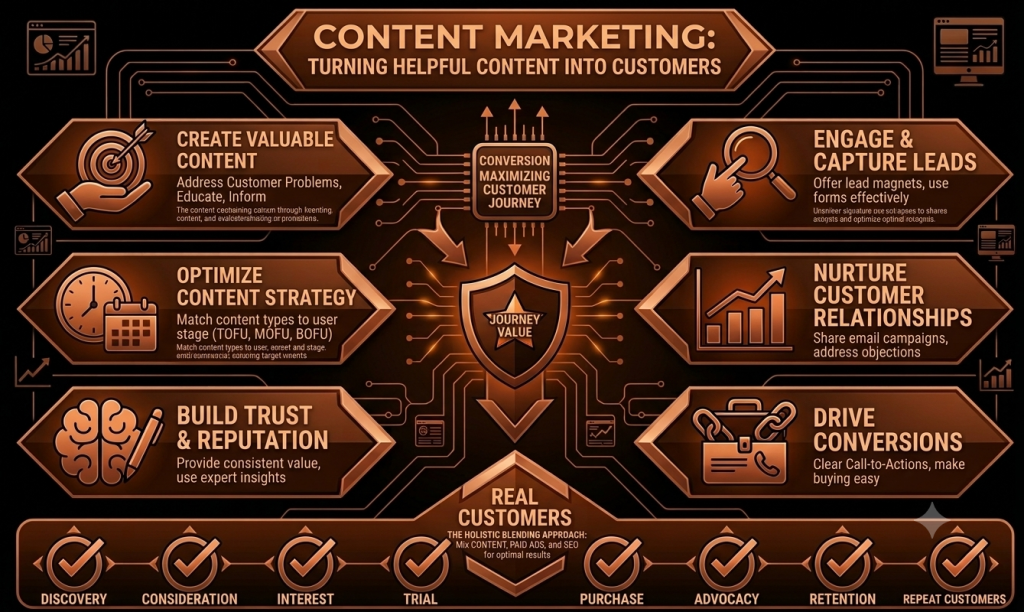
Content Marketing: How to Turn Helpful Content Into Real Customers
Plenty of businesses publish blogs, guides, social posts, and videos every month, and still struggle to connect any of it to actual sales. Traffic goes up. Enquiries don’t. This is where a lot of businesses quietly get stuck — they’ve figured out how to get people to consume content, but not how to create content that actually moves people toward a buying decision.
Those are two different skills. Getting attention is the easy part. The real question is what happens after someone reads your article — do they leave and forget you, or do they walk away trusting you a little more than before?
This article looks at how content marketing actually works: how helpful content attracts the right audience, answers their real questions, builds trust, removes hesitation, and gradually guides someone toward becoming a customer.
Quick Answer: Content marketing turns visitors into customers by attracting the right audience, genuinely solving their problems, building trust through useful information, introducing relevant products or services once that trust exists, offering a clear next step, and nurturing interested visitors until they’re ready to buy.
What Is Content Marketing?
Content marketing means creating genuinely useful content — articles, guides, videos, or other formats — built around what your potential customers actually want to know, rather than content built purely to promote your business. The simple idea is this: help first, sell later.
It differs from traditional advertising in an important way. An ad interrupts someone to make a pitch. Content marketing earns attention by being genuinely useful, then lets trust do the persuading. A landscaping company writing “when to prune your hedges before winter” isn’t selling anything in that moment — it’s demonstrating expertise to someone who might need landscaping help eventually.
Why Helpful Content Matters
Most people research before they contact or buy from a business — reading reviews, comparing options, and looking for someone who clearly understands their problem. Content is often the first real interaction someone has with your business, long before any sales conversation happens.
Genuinely useful content builds trust and demonstrates expertise, supports brand awareness, helps search visibility, educates the customer before they ever talk to you, solves real problems, and encourages better engagement than purely promotional material. All of that quietly builds the confidence someone needs before they’re willing to buy.
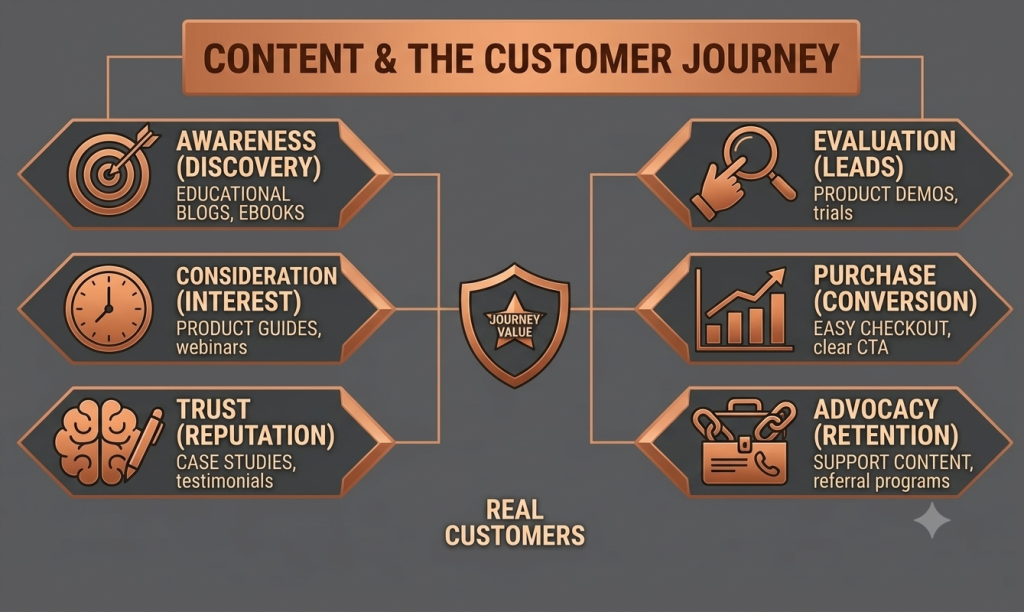
How Content Supports the Customer Journey
Awareness: The customer realizes they have a problem. This is where blog posts, educational videos, social content, beginner guides, and infographics tend to work well — broad, accessible content that meets someone at the very start of their search.
Consideration: The customer starts researching solutions. Detailed guides, comparisons, case studies, checklists, webinars, and expert articles help here, since the reader is now actively weighing options.
Decision: The customer is close to choosing. Service pages, product comparisons, testimonials, case studies, FAQs, demonstrations, and clear pricing information matter most at this stage.
Conversion: The customer is ready to act. This is where contact forms, consultation requests, free trials, purchase options, calls, demo requests, and newsletter signups give them an obvious next step.
How to Turn Helpful Content Into Real Customers
1. Create content around real customer problems. Start from the actual questions and frustrations your customers have, not topics that sound good in a content calendar.
2. Match content with search intent. Informational searches (“how to”) call for educational content, commercial searches (“best,” “compare”) call for comparisons, and transactional searches (“buy,” “book”) call for content closer to a decision.
3. Give genuine answers before selling. This is where many businesses go wrong — rushing to promote before actually answering the question the reader came with.
4. Build trust through expertise. Real experience, original insights, concrete examples, relevant data, and honest case studies do more for credibility than generic advice anyone could have written.
5. Add relevant calls to action. A natural next step — not a hard pitch — guides interested readers toward learning more.
6. Connect blog content with service pages. Internal links let genuinely interested readers discover the relevant service without having to go searching for it themselves.
7. Use lead magnets where appropriate. A free checklist, guide, template, or consultation can capture interest — but only if it’s genuinely useful, not a thin excuse to collect an email address.
8. Create content for different buying stages. One blog post can’t serve everyone from first-time researchers to ready-to-buy customers — plan content across the journey, not just at the top of it.
9. Use social proof. Testimonials, reviews, case studies, and real client results reduce the hesitation that keeps people from taking the next step.
10. Make the next step easy. A visitor shouldn’t have to hunt through your website to figure out what to do after reading — that friction quietly loses people who were otherwise interested.
Content Types That Can Generate Customers
Blog posts and how-to guides tend to work well for awareness and early education. Case studies and comparison articles support consideration, when someone is actively weighing their options. FAQs, videos, and service or product guides help at the decision stage, answering the specific hesitations someone has left. Social media content and email newsletters help distribute and reinforce your content across a wider audience, while checklists and ebooks work well as lead magnets that capture genuine interest.
No single format needs to carry the whole journey — different pieces do different jobs.
The Content Marketing Funnel
A simple way to see the whole process: Helpful Content → Website Visit → Trust → Engagement → Lead → Follow-Up → Customer.
Someone finds a genuinely helpful piece of content, visits your website, and starts building trust as they read. If the content is useful enough, they engage further — reading another article, browsing a service page. At some point, a relevant offer or CTA turns that interest into a lead. From there, genuine follow-up (not just automated emails) helps carry that lead toward actually becoming a customer.
Choosing the Right Call to Action
Not every piece of content needs a hard sales pitch — the right CTA depends on where the reader is in their journey.
Soft CTA (early-stage content): “Read the related guide,” “Explore our services,” “Download the checklist.”
Medium CTA (building interest): “Subscribe to the newsletter,” “Request a consultation,” “Get the free guide.”
Strong CTA (decision-ready content): “Contact us,” “Book a consultation,” “Request a quote,” “Buy now.”
Using a strong CTA on an early-awareness article usually feels pushy and out of place — matching the CTA to the content’s stage tends to convert better than defaulting to the hardest sell everywhere.
A Realistic Content Marketing Example
Consider a fictional local web development company. A potential customer searches “why is my website slow,” and finds a genuinely helpful article explaining common causes. The article links to a related guide on choosing reliable web hosting, which builds further trust. From there, the reader browses the company’s website redesign service page, sees a few honest client testimonials, and requests a free consultation through a clear CTA.
The company follows up personally rather than with a generic automated response, answers the person’s specific concern, and eventually converts the lead into a paying client. This is a hypothetical, illustrative journey — real results vary by business, industry, and execution, and no specific outcome is guaranteed.
Content Marketing and SEO
Content marketing and SEO work closely together, though they aren’t the same thing. SEO isn’t simply about inserting keywords into an article — it’s about matching genuinely helpful content to real search intent, supported by sensible internal linking, strong topical coverage, and a good overall user experience.
Good content marketing naturally supports SEO because it’s built around real questions people search for, and good SEO practices — clear structure, relevant keywords, useful internal links — help that content actually get found.
Content Marketing and Social Media
A single well-made piece of content can go a long way when repurposed: one blog → a LinkedIn post → Instagram content → a short video → an email → an FAQ entry → sales content.
Distributing content across platforms helps reach people who might never have found the original article through search — someone scrolling social media isn’t necessarily searching Google, but they might still be exactly the right audience for that same helpful information.
Common Content Marketing Mistakes
- Writing only for search engines — producing content that reads awkwardly because it’s built around keywords instead of people.
- Creating content without understanding the audience — guessing at topics instead of researching real customer questions.
- Publishing random topics — with no connection to what your business actually offers.
- Focusing only on traffic — celebrating page views that never turn into leads.
- Over-promoting products or services — turning every article into a pitch, which erodes trust.
- Weak CTAs — or none at all, leaving interested readers with no next step.
- No internal linking — isolating content instead of connecting it to relevant services.
- Ignoring older content — letting genuinely useful articles go stale instead of updating them.
- Not measuring conversions — tracking traffic without ever checking what it actually produces.
- Publishing content without a distribution strategy — hoping people find it rather than actively sharing it.
- Copying competitors — instead of offering genuinely original insight.
- Using generic AI-generated content without adding real value — publishing content that reads like everyone else’s, with nothing genuinely useful added.
How to Measure Whether Content Is Generating Customers
Useful metrics include organic traffic, engagement, time on page where it’s meaningful, scroll depth where available, click-through rate, leads, form submissions, calls, email signups, consultation requests, conversion rate, assisted conversions, and revenue where it can be measured.
Traffic alone doesn’t always mean business success — an article can get plenty of visits and still generate very few leads if it doesn’t guide readers toward a next step. Looking at the fuller picture, from traffic through to actual conversions, gives a much more honest read on performance.

A Content Marketing Strategy for Small Businesses
You don’t need a huge volume of content to get real value from this approach. A practical process:
- Identify the real problems your customers have
- Find the questions they commonly ask
- Choose topics genuinely worth writing about
- Create content that’s actually helpful, not just present
- Optimize it for relevant search terms
- Add internal links to relevant service pages
- Include a natural, stage-appropriate CTA
- Promote the content through relevant channels
- Measure leads and conversions, not just traffic
- Improve the content that’s already performing well
A Simple Content-to-Customer Framework
A memorable way to hold the whole idea together: Problem → Helpful Answer → Trust → Relevant Solution → CTA → Follow-Up → Customer.
Every piece of content should be able to answer: what problem does this solve, does it genuinely help before asking for anything, and what’s the natural next step once someone’s read it?
Frequently Asked Questions
- What is content marketing?
Content marketing is creating genuinely useful content — articles, guides, videos, and more — built around what your potential customers actually want to know, rather than content built purely to promote your business directly. - How does content marketing help a business get customers?
It attracts people already searching for answers related to your business, builds trust by genuinely helping them, and gradually guides interested readers toward becoming leads and eventually customers. - Can content marketing generate leads?
Yes, when content is paired with a clear, relevant next step — a CTA, a lead magnet, or an internal link to a service page — genuinely helpful content can turn interested readers into real leads. - What type of content attracts customers?
Content that directly answers real customer questions tends to attract the most engaged audience. The right format — blog post, guide, video, case study — depends on where that customer is in their decision-making journey. - How long does content marketing take to work?
It varies by industry, competition, and consistency, but meaningful results typically build over months rather than days. Content marketing tends to compound over time rather than deliver instant results. - Is content marketing better than paid advertising?
Neither is universally better — they solve different problems. Content marketing builds longer-term trust and organic visibility, while paid advertising can generate faster, more immediate visibility. - How often should a business publish content?
Consistency matters more than frequency. A business that publishes genuinely useful content on a sustainable, regular schedule tends to do better than one publishing frequently but with little real value. - How do you measure content marketing success?
Track metrics tied to real outcomes — leads, form submissions, calls, and conversions — alongside traffic and engagement, since traffic alone doesn’t always translate into actual business results. - Can small businesses use content marketing?
Yes, and often quite effectively. Small businesses don’t need huge volumes of content — a focused set of genuinely helpful articles addressing real customer questions can perform very well. - How do you turn blog readers into customers?
By giving genuine value first, building trust through expertise and social proof, connecting relevant content to your services through internal links, and offering a clear, easy next step for interested readers.
Conclusion
Content marketing isn’t simply about publishing more articles. It’s about creating genuinely useful content for the right people, answering their real questions, building trust along the way, guiding them toward the right solution, and making the next step easy once they’re ready.
Traffic is only the first step — the real question is always what happens next. If your content is currently generating visits but not conversations or enquiries, that gap between attention and trust is usually where the opportunity is. Taking a closer look at your existing content with that lens is often the fastest way to find where to improve.