
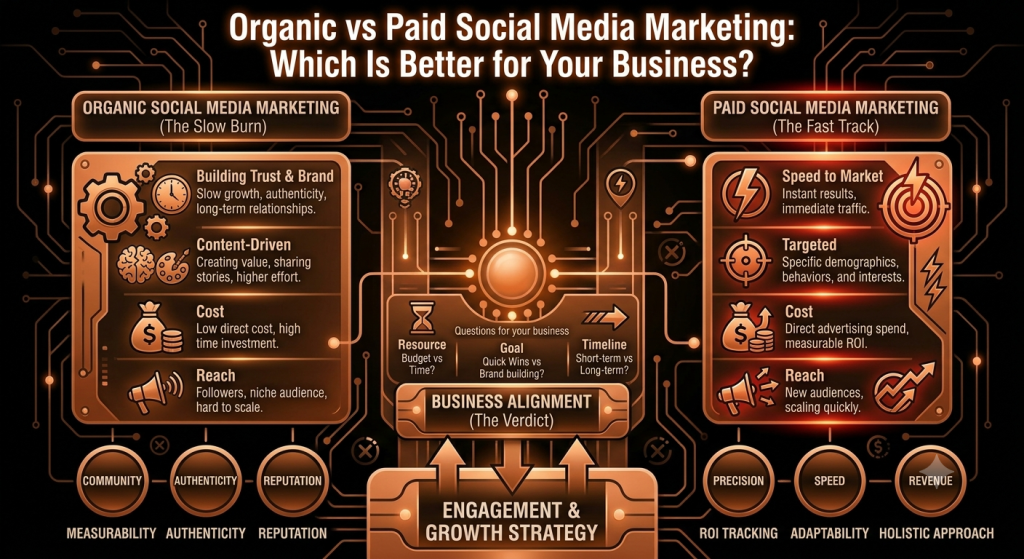
Organic vs Paid Social Media Marketing: Which Is Better for Your Business?
A business posts regularly, puts real effort into its content, and still ends up with limited reach, a handful of likes, and barely any enquiries. Meanwhile, a competitor runs a paid campaign and gets in front of thousands of people within days — but that costs money, and it’s not always clear whether it’s actually worth it.
That tension is where most businesses land at some point: should you focus on organic social media, paid social media, or both? The short answer is that neither approach is universally better. Organic and paid social media solve different problems, and the right mix depends on your goals, audience, budget, and stage of growth.
This article breaks down what organic vs paid social media marketing actually means, how they compare on cost, speed, reach, and results, and how to decide which one deserves more of your time and money right now.
What Is Organic Social Media Marketing?
Organic social media marketing is the unpaid activity of posting content, engaging with your audience, and building relationships on social platforms — regular posts, reels and short-form video, stories, educational content, carousels, polls, questions, comments, behind-the-scenes content, customer stories, user-generated content, and thought leadership.
Organic reach is how many people naturally see your content without paid promotion, and organic engagement is how they interact with it — likes, comments, shares, saves. Organic followers are people who chose to follow you without being targeted by an ad.
It’s worth being clear about one thing: organic doesn’t mean free. Businesses often still spend money on content creation, design, video production, social media management, tools, strategy, and staff time. What makes it “organic” is that the distribution itself isn’t paid for.
What Is Paid Social Media Marketing?
Paid social media marketing is advertising on social platforms — sponsored posts, ad campaigns, and boosted content that you pay to distribute to a specific audience. It typically involves audience targeting, retargeting, campaign objectives, a budget, bidding, ad creatives, landing pages, and conversion tracking.
Common paid activities include running campaigns on platforms like Facebook, Instagram, LinkedIn, TikTok, and YouTube. Advertising features and targeting options differ between platforms and change over time, so it’s worth checking a platform’s own advertising resources before planning a campaign in detail.
Organic vs Paid Social Media Marketing: Key Differences
| Factor | Organic Social Media | Paid Social Media |
|---|---|---|
| Cost | No ad spend, but time and content costs | Requires ongoing ad budget |
| Reach | Depends on content and platform algorithm | Controlled and scalable with budget |
| Speed | Builds gradually over time | Can distribute quickly once live |
| Audience targeting | Limited to who follows or discovers you | Detailed, adjustable targeting options |
| Engagement | Often deeper, from an invested audience | Can be lower unless the creative resonates |
| Brand building | Strong for personality and trust | Useful for controlled exposure and recall |
| Lead generation | Possible, but usually slower | Can be direct and measurable |
| Sales | Supports the buying decision over time | Can drive direct conversions with the right setup |
| Long-term value | Compounds as content and trust build up | Results generally pause when spending stops |
| Control | Limited by algorithm and platform changes | More control over who sees what, and when |
| Content requirements | Needs a consistent content pipeline | Needs strong, tested creatives |
| Measurement | Engagement-focused metrics | Precise, campaign-level performance data |
| Best use cases | Trust, community, long-term brand presence | Launches, promotions, lead generation, retargeting |
None of these are absolutes. Organic isn’t free, paid doesn’t guarantee sales, and organic isn’t automatically “better long term” — context decides which strengths actually matter for your business.
Benefits of Organic Social Media Marketing
Builds long-term audience relationships. People who follow you organically chose to, which tends to make the relationship more durable than one built purely through ad exposure.
Supports brand personality. Organic content gives you room to show tone, humor, and values — things that are harder to convey in a short paid ad.
Encourages community engagement. Comments, replies, and conversations happen more naturally when people aren’t just reacting to an ad.
Helps establish credibility. A consistent, genuine presence signals that a business is active and real, not just running ads and disappearing.
Provides ongoing content assets. Organic posts can be repurposed into ads, email content, or website material later.
Can support customer retention. Existing customers who keep seeing useful content stay connected to your business between purchases.
Helps businesses understand their audience. Comments and engagement patterns reveal what people actually respond to.
Supports brand awareness. Regular, recognizable content keeps your business top of mind over time.
Allows businesses to test content ideas. Organic posts are a low-cost way to see what resonates before spending on ads.
Can complement other digital marketing channels. Strong organic content supports SEO, email marketing, and paid campaigns alike.
Disadvantages of Organic Social Media Marketing
- Results can take time to build, especially for newer accounts
- Reach can be unpredictable and depends heavily on platform algorithms
- It requires a consistent content pipeline, which takes real time and effort
- Active community management is needed to make engagement meaningful
- Content creation can be resource-intensive, particularly video
- Competition for attention on any given platform is high
- Reach may vary significantly by platform and audience, even for similar content
- Consistency helps, but it doesn’t guarantee growth on its own
Benefits of Paid Social Media Marketing
Paid social media offers faster audience reach, detailed targeting options based on demographics, interests, and behavior, and clear campaign objectives you can set from the start. Successful campaigns can be scaled up with budget, and paid ads can directly support lead generation, website traffic, product promotion, and retargeting people who already showed interest.
Performance is measurable in detail, which makes it possible to test different audiences and creatives systematically. Paid campaigns are also particularly useful for supporting launches and time-sensitive promotions that can’t wait for organic momentum to build.
It’s worth being direct here: paid advertising can accelerate distribution, but spending money does not automatically create profitable results. A weak offer or a poorly matched audience will still underperform, no matter the budget behind it.
Disadvantages of Paid Social Media Marketing
- Requires an ongoing budget to sustain results
- Poor targeting can waste spend on the wrong audience
- Weak creatives tend to reduce performance regardless of targeting quality
- Ad costs can fluctuate based on competition and demand
- Results generally decline once a campaign stops running
- Ongoing tracking and optimization are needed to keep performance healthy
- Businesses become somewhat dependent on the platform’s advertising system
- Conversion depends on the full customer journey, not the ad alone
- Ads can’t fix a poor offer or a weak landing page — they just send more people to it
Organic vs Paid Social Media: Which Gives Faster Results?
Paid campaigns generally distribute content faster, because you’re directly paying for additional reach or a specific campaign outcome. Organic growth tends to take longer, since it depends on content quality, audience response, consistency, relationships, and how the platform’s algorithm chooses to distribute your posts.
Faster reach doesn’t automatically mean better business results, though. It helps to think in terms of the fuller path: Reach → Engagement → Traffic → Leads → Sales → Profit. A paid campaign can move people through the first step quickly, but every step after that still depends on your offer, your landing page, and your follow-up process.
Which Is Better for Small Businesses?
It genuinely depends on the situation. Organic tends to be especially useful when a business has a limited advertising budget, is building a new brand from scratch, is community-focused, runs as a personal brand, has strong educational content to share, or needs to establish trust before asking for a sale.
Paid tends to be useful for time-sensitive offers, product launches, lead generation, local promotions, e-commerce campaigns, event promotion, retargeting, and businesses that already have a strong offer and a working conversion process behind it.
No single strategy works for every small business — the right starting point depends on your budget, your offer, and how quickly you need results.
Which Is Better for Brand Awareness?
Organic content builds familiarity, personality, trust, and community over time — people get to know a business gradually, through repeated, genuine exposure. Paid social media builds controlled reach among a specific audience, putting your brand in front of people who might not have found you organically at all.
Combining both often produces stronger brand awareness than either alone: paid introduces your business to new people, while organic content gives them a reason to actually remember and trust it.
Which Is Better for Lead Generation and Sales?
It helps to separate a few distinct steps: audience building, traffic generation, lead generation, and conversion. Paid campaigns are often useful for direct response goals — getting someone to fill out a form or make a purchase relatively quickly. Organic content tends to work further upstream, educating prospects and building trust before they’re ready to act.
Actual performance for either approach depends on your offer, audience, creative, targeting, landing page, follow-up process, sales process, and tracking. Neither organic nor paid social media can compensate for weaknesses in the rest of that chain.
Organic vs Paid Social Media Cost
Organic costs typically include content creation, staff time, social media management, design, video production, tools, and strategy — real costs, even without a media spend line item. Paid costs include ad spend itself, creative production, campaign management, tracking setup, landing pages, and testing.
There’s no universal price that applies to every business. Advertising costs vary by platform, industry, audience, location, competition, campaign objective, and creative quality — what a restaurant pays per lead in one city can look very different from what a B2B consultancy pays elsewhere.
Can You Use Organic and Paid Social Media Together?
Yes — in many cases, using both creates a stronger overall strategy. A practical model looks like this: publish organic content, identify which posts genuinely resonate, put paid promotion behind that proven content, use it to reach new audiences, retarget people who engaged, guide them toward converting, and continue the organic relationship afterward.
Organic content is a useful, low-cost way to learn what resonates with your audience before committing a larger budget to paid promotion. That said, not every organic post needs to become an ad — the goal is testing and learning, not automatically boosting everything.
How to Build a Combined Organic + Paid Social Media Strategy
- Define the business goal — awareness, leads, sales, or retention.
- Identify the target audience — who you’re actually trying to reach.
- Choose the right platforms — based on where that audience spends time.
- Build an organic content system — something sustainable, not sporadic.
- Create different content categories — educational, behind-the-scenes, social proof, offers.
- Monitor performance — track engagement and see what’s landing.
- Identify strong content and offers — the posts and offers worth investing further in.
- Launch targeted paid campaigns — behind your strongest content and offers.
- Test different creatives and audiences — systematically, not randomly.
- Retarget relevant users — people who already showed interest.
- Measure business outcomes — leads, sales, and revenue, not just clicks.
- Improve and scale — put more budget and effort behind what’s working.
Organic vs Paid Social Media Examples
The following are hypothetical examples meant to illustrate how the two approaches might work together — not real case studies or verified results.
Example 1: Local Restaurant. Organic content — daily specials, behind-the-scenes kitchen clips, customer photos — could build local awareness and familiarity over time. A paid campaign could then promote a specific weekend offer to people nearby who haven’t visited yet.
Example 2: E-commerce Business. Organic content could demonstrate products in use, answer common questions, and feature customer photos, while paid campaigns support product promotion, seasonal sales, and retargeting people who viewed a product but didn’t purchase.
Example 3: Service-Based Business. Organic educational content — tips, explainers, FAQs — could establish expertise and trust, while a paid lead-generation campaign targets people actively searching for that specific service.
Common Mistakes Businesses Make
- Depending only on organic reach — and expecting it to move as fast as a paid campaign would.
- Spending money on ads without a strategy — have a clear objective before you spend.
- Boosting every post — rather than the ones that already show genuine promise.
- Targeting everyone — broad targeting usually wastes budget on uninterested people.
- Creating ads without testing — launch a single untested creative and hope it performs.
- Ignoring organic content — and relying entirely on paid distribution.
- Focusing only on vanity metrics — likes and follower counts over real outcomes.
- Not tracking conversions — running campaigns with no visibility into what they actually produced.
- Sending traffic to weak landing pages — undermining otherwise solid ad targeting.
- Expecting immediate sales — from either organic or paid efforts.
- Buying followers — inflating numbers without adding real customers.
- Copying competitors — instead of building an approach suited to your own audience.
- Ignoring audience feedback — missing signals about what actually resonates.
- Changing campaigns too quickly — without giving them enough data to evaluate fairly.
How to Decide Between Organic and Paid Social Media
Lean more organic when:
- You want long-term brand building
- You have a limited advertising budget
- You want to build a genuine community
- Your content can educate or entertain effectively
- Trust needs to be established before a sale is realistic
Lean more paid when:
- You need faster distribution
- You have a clear, tested offer
- You want precisely targeted reach
- You need leads or sales on a specific timeline
- You’re launching something new
- You have measurable conversion tracking in place
Use both when:
- You want long-term growth alongside faster distribution
- You already have content worth promoting further
- You want to test ideas organically before scaling them with budget
- You want to combine awareness, trust, and conversion in one strategy
How to Measure Organic Social Media Performance
Useful organic metrics include reach, impressions, engagement rate, likes, comments, shares, saves, video views, watch time, profile visits, website clicks, followers, leads, and conversions.
Which of these matters most depends entirely on your goal — an awareness-focused account should care more about reach and impressions, while a lead-focused account should watch profile visits, website clicks, and actual conversions. Follower count alone doesn’t represent success on its own.
How to Measure Paid Social Media Performance
Paid campaigns are typically measured through reach, impressions, CTR (click-through rate — the percentage of people who click after seeing your ad), CPC (cost per click), CPM (cost per thousand impressions), conversion rate, cost per lead, CPA (cost per acquisition), ROAS (return on ad spend — revenue generated for every unit of ad spend), revenue, and qualified leads.
Not every business should optimize for the same metric. A brand-awareness campaign might reasonably prioritize reach and CPM, while a direct-response campaign should focus on cost per lead, conversion rate, and ROAS.
Frequently Asked Questions
- What is the difference between organic and paid social media marketing?
Organic social media relies on unpaid content and engagement to build an audience over time, while paid social media uses advertising budget to distribute content to a targeted audience quickly. Both can support the same business goals in different ways. - Is organic social media marketing free?
Not entirely. There’s no ad spend involved, but businesses still typically invest time, content creation, design, and sometimes staff or tools to run it well. - Is paid social media marketing better than organic?
Neither is universally better — they serve different purposes. Paid tends to be faster and more targeted, while organic tends to build deeper trust and community over time. - Which is better for small businesses?
It depends on the business’s budget, goals, and stage. Organic often makes sense with a limited budget or when building trust, while paid can help with faster, more targeted results when there’s a clear offer. - Which gives faster results?
Paid social media generally distributes content faster since you’re directly paying for reach. Organic growth typically builds more gradually through consistent content and engagement. - Can organic social media generate sales?
Yes, though usually more gradually. Organic content can build the trust and familiarity that eventually lead someone to make a purchase, even without a direct ad. - Is paid social media worth the money?
It can be, when there’s a clear objective, a tested offer, and proper tracking in place. Without those, ad spend often produces clicks and impressions without meaningful business results. - Should a new business start with organic or paid social media?
Many new businesses start with organic to build an initial audience and test content and messaging, then add paid campaigns once they better understand what resonates. - Can organic and paid social media be used together?
Yes, and doing so often works better than relying on just one. A common approach is testing content organically, then promoting the strongest performers with paid budget. - How much should a business spend on social media advertising?
There’s no fixed number — budgets vary widely based on industry, audience, location, competition, and objective. It’s more useful to start with a clear goal and a budget you can realistically test with. - How long does organic social media marketing take to work?
It varies by platform, content quality, and consistency, but meaningful organic growth typically takes weeks to months of sustained effort rather than appearing overnight. - How do you measure social media marketing success?
By tracking metrics tied to your actual goal — reach and engagement for awareness, or leads, conversion rate, and cost per lead for sales-focused campaigns — rather than relying on follower count alone.
Conclusion
There’s no universal winner between organic and paid social media marketing. Organic is valuable for building relationships, trust, content assets, and long-term brand presence. Paid is valuable when a business needs controlled reach, targeted distribution, lead generation, promotion, or faster testing.
For many businesses, the strongest approach is using both strategically — organic content to build trust and learn what resonates, paid campaigns to extend reach and drive specific outcomes. If you’re not sure where to start, take an honest look at your current social media activity and match it against your actual goal, budget, and timeline before deciding where to invest next.