
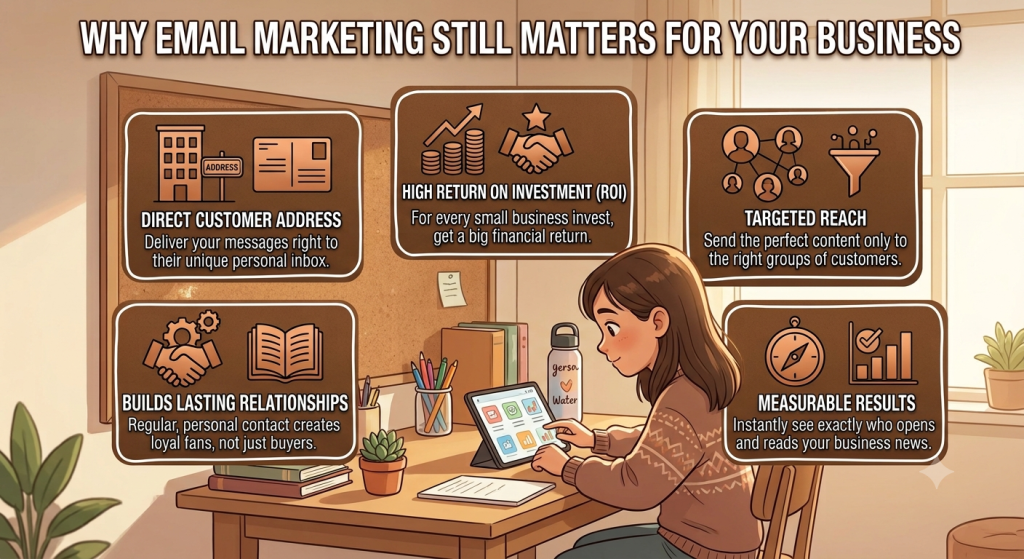
Why Email Marketing Still Matters for Your Business
Every year or two, someone declares email marketing dead. Social media took over, then video took over, then AI chat took over — and yet inboxes are still full, and businesses are still using email to close deals, retain customers, and stay in touch with people who matter to them.
Businesses have more digital channels than ever now, which makes it worth asking honestly: why does email still have a place? The short version is that email gives you something most other channels don’t — a direct line to people who’ve actually chosen to hear from you, and a way to nurture relationships, generate leads, support sales, and bring customers back.
This article looks at why email marketing still matters, in practical terms, without pretending it’s the only channel that counts.
Quick Answer: Email marketing remains useful because it lets businesses communicate directly with people who’ve chosen to hear from them, nurture relationships over time, share genuinely useful information, promote relevant offers, generate leads, and encourage repeat purchases — all without depending entirely on a social platform’s algorithm.
Is Email Marketing Still Relevant Today?
“Isn’t email outdated?” is a fair question. The way people use digital channels has genuinely changed — more scrolling, more short video, more messaging apps. But businesses still need reliable ways to reach prospects and customers directly, and email remains one of the few channels where that reach isn’t controlled by someone else’s algorithm.
Email isn’t meant to replace SEO, social media, or advertising. It works alongside them. It’s not accurate to call any single channel the “best” one — what matters is how well each channel fits your specific business and audience.
Email Gives You a Direct Communication Channel
There’s a useful way to think about this: an owned audience versus a rented audience. Your email list is something you actually own — subject to applicable consent and marketing rules, you can reach those people directly, without a platform deciding whether your message shows up in their feed.
Social media followers, by contrast, are more like a rented audience. The platform controls distribution, and that can shift. Neither situation is guaranteed forever, but owning a list gives you a layer of communication that doesn’t depend entirely on someone else’s system.
Email Helps Build Customer Relationships
Email isn’t only about selling. Businesses use it to educate customers, answer common questions, share genuinely helpful information, introduce new products or services, give updates, share useful resources, build familiarity, and simply stay connected between purchases.
Consistent, useful communication builds relationships over time in a way a single ad or post rarely can. Someone who’s received a year of genuinely helpful emails from you feels differently about your business than someone who’s only seen your ads.
Email Can Support Lead Generation
Email can turn an interested but anonymous visitor into an identifiable lead. The general process: Website Visitor → Useful Offer → Email Signup → Nurturing → Sales Conversation → Customer.
Common lead magnets include guides, checklists, templates, free consultations, reports, useful resources, and educational newsletters. The key is offering something genuinely useful — just collecting emails without giving real value tends to attract low-quality, disengaged subscribers.
Email Can Support Sales
Email can move potential customers closer to a purchase through product announcements, service offers, educational emails, genuine customer stories, case studies, product comparisons, FAQs, occasional limited-time offers (when they’re real), and follow-up emails after someone shows interest.
There’s a real difference between helpful selling — giving someone the information they need to decide — and aggressive selling, which tends to push people away. Spammy or manipulative tactics aren’t worth the short-term gain.
Email Helps With Customer Retention
Getting a customer isn’t the end of marketing. Email supports retention through thank-you emails, onboarding, product education, helpful tips, updates, feedback requests, encouraging repeat purchases, relevant cross-sell opportunities, and general loyalty communication.
Retaining existing customers is often a meaningful part of sustainable growth — though exact retention figures vary too much by business and industry to state a universal number.
Personalization Makes Email More Relevant
Simple personalization can include a customer’s name, their previous purchase, something they showed interest in, content they downloaded, a service they viewed, their customer type, or their location when it’s relevant.
Done well, personalization makes communication feel more relevant, not invasive. The line is usually about usefulness — referencing something that genuinely helps tailor the message, rather than collecting and displaying data just because you can.
Email Marketing Can Support Different Types of Businesses
Local businesses (a salon, restaurant, clinic, or local service provider) can use email for appointment reminders, local offers, and staying connected between visits.
Service businesses (a digital marketing agency, consultant, or coach) can use email for education, case studies, and nurturing leads through a longer sales cycle.
Ecommerce businesses can use email for product updates, appropriate abandoned-cart communication, product education, and repeat-purchase campaigns.
Professional and B2B businesses can use email for thought leadership, updates, and relationship-building over longer decision cycles.
Startups can use email for product education, onboarding, updates, and building an audience before launch.
The same exact strategy doesn’t work equally well everywhere — the format matters, but the underlying idea (genuine, useful communication) holds across all of them.
Email Marketing vs. Social Media: What's the Difference?
| Factor | Email Marketing | Social Media |
|---|---|---|
| Audience ownership | You own the list | The platform controls access |
| Communication | Direct, one-to-one feeling | Public, broadcast-style |
| Content lifespan | Sits in the inbox | Often short-lived in the feed |
| Personalization | Easier to tailor individually | Generally broader targeting |
| Lead nurturing | Well suited for it | Possible, but less direct |
| Platform dependency | Lower | Higher |
Neither is a universal winner. They tend to serve different roles, and many businesses get the most value from using both together.
Email Marketing vs. Paid Advertising
Advertising is generally better at attracting new audiences who don’t know you yet. Email tends to be better at nurturing people who’ve already subscribed and shown some interest.
Paid campaigns require ongoing ad spend to keep working. Email campaigns have their own costs and operational effort — a platform subscription, content creation, list management — but don’t require continuous spend just to reach your existing list. The two channels tend to work well together: ads bring people in, email keeps the relationship going.
Email Marketing Can Help Small Businesses
For smaller businesses, email supports staying connected with customers, promoting offers, building repeat business, sharing educational content, nurturing leads over time, announcing new services, and gradually building a subscriber base.
It’s worth being honest that email marketing isn’t automatically free — you still need a reasonable platform, a strategy, actual content, and ongoing list management. It’s often more accessible than paid advertising, but it still takes real effort.
Different Types of Emails Businesses Can Send
Welcome emails introduce your business right after signup. Newsletter emails keep subscribers updated on a regular basis. Educational emails teach something genuinely useful. Promotional emails highlight offers or discounts. Product or service updates announce what’s new. Lead-nurturing emails move interested subscribers closer to a decision. Follow-up emails respond after a specific action. Customer retention emails keep existing customers engaged. Re-engagement emails try to win back inactive subscribers.
A fitness coach, for example, might send a welcome email with a starter workout, a weekly educational tip, an occasional program offer, and a re-engagement email to subscribers who haven’t opened anything in months.
How Often Should a Business Send Emails?
There’s no single perfect frequency. It depends on your audience, business type, content quality, customer expectations, marketing goals, and the type of email involved.
As rough starting points, not guaranteed formulas: a weekly newsletter works for many content-driven businesses, while a monthly update might suit a lower-frequency service business. Consistency and relevance generally matter more than hitting a specific number of emails per week.
What Makes an Email Effective?
- A clear subject line that sets accurate expectations
- Genuinely useful content, not filler
- Strong relevance to the specific subscriber
- Simple, easy-to-read writing
- One clear main action, not five competing ones
- Good formatting that’s easy to scan
- A mobile-friendly design
- A trustworthy, recognizable sender identity
- A relevant, well-timed offer
- A clear call to action
Why Some Email Marketing Campaigns Fail
Common causes include buying email lists, sending irrelevant content, sending only promotional emails, sending too frequently, sending too rarely, weak subject lines, poor CTAs, no segmentation, no personalization, a poor mobile experience, ignoring unsubscribes, not tracking results, making misleading claims, and sending emails without appropriate permission.
Any one of these can quietly undermine an otherwise reasonable strategy — a great subject line still won’t save an email nobody asked for.
How to Measure Email Marketing Success
Relevant metrics include open rate, click-through rate, conversion rate, unsubscribe rate, bounce rate, leads generated, sales generated, and revenue attributed to email where it can be measured.
Which metric matters most depends on your goal. If the goal is lead generation, track leads and conversions. If it’s sales, track purchases and revenue. If it’s engagement, track clicks and meaningful interactions. No single metric proves success on its own.
How Email Marketing Works With SEO and Content Marketing
A simple relationship: SEO → Website Visitors → Content → Email Signup → Email Nurturing → Customer.
A blog post can attract visitors through search, and a relevant lead magnet can turn interested readers into subscribers. From there, email helps distribute future content back to that same audience — the channels genuinely reinforce each other rather than competing.
SEO, AEO, and GEO in Context
SEO helps businesses attract people actively searching for relevant information, products, or services. AEO (answer engine optimization) is about clearly answering common customer questions, which makes your content more useful in answer-focused search experiences. GEO (generative engine optimization) is about presenting clear, trustworthy, structured information that’s easier for AI-powered search experiences to understand.
None of these guarantee rankings, citations, traffic, or AI visibility — they’re about improving your odds through genuinely useful, well-structured content, not a shortcut to a specific result.
A Simple Email Marketing Strategy for Beginners
Step 1: Define your audience. Be specific about who you’re writing for.
Step 2: Build an email list properly. With genuine permission, not shortcuts.
Step 3: Create a useful signup offer. Something worth trading an email address for.
Step 4: Set up a welcome email. Deliver the offer and set expectations.
Step 5: Send helpful content. Give real value before asking for anything.
Step 6: Introduce relevant offers. Once trust is established.
Step 7: Segment your subscribers. Group by interest or stage where useful.
Step 8: Follow up. Respond to engagement and interest promptly.
Step 9: Measure results. Track what actually matters to your goal.
Step 10: Improve based on data. Adjust rather than guessing.
A Fictional Business Example
Picture a small local business with steady website visitors and existing customers, but no real email strategy. It could start with a simple signup offer on its website, follow with a warm welcome email, send weekly helpful content, gradually segment subscribers by interest, introduce relevant offers once trust builds, follow up on any engagement, and send occasional retention emails to existing customers.
This is a fictional, illustrative example — not a case study, with no specific revenue figures implied or guaranteed.
The Future Role of Email Marketing
Email marketing will likely keep evolving alongside AI, deeper personalization, automation, customer data practices, privacy expectations, omnichannel marketing, and better segmentation tools.
Technology will probably keep changing how businesses use email. What seems unlikely to change is the basic need for useful, relevant, permission-based communication with people who actually want to hear from you — that part of the equation tends to outlast any particular tool or trend.
Email Marketing Checklist for Businesses
- Do we have a clear target audience?
- Are we collecting emails with appropriate permission?
- Do we provide a genuinely useful reason to subscribe?
- Do we have a welcome email in place?
- Are our emails actually useful, not just promotional?
- Are our offers relevant to the subscriber?
- Are our CTAs clear?
- Are our emails mobile-friendly?
- Are subscribers properly segmented where it matters?
- Are we tracking conversions, not just opens?
- Are we making unsubscribing easy?
- Are we avoiding misleading claims?
- Are we regularly reviewing and improving the strategy?
Responsible Email Marketing
Businesses should obtain appropriate permission for marketing emails, follow applicable privacy and marketing laws, make unsubscribe options clear and easy, avoid misleading subject lines, avoid deceptive sender information, respect subscriber preferences, keep subscriber data secure, and avoid purchasing low-quality email lists.
This isn’t legal advice — regulations and platform requirements vary by region and change over time, so check current rules that apply to where you operate before finalizing your approach.
Frequently Asked Questions
Is email marketing still effective?
Yes, for most businesses it remains a genuinely useful channel, particularly for nurturing relationships, generating leads, and supporting sales, though results vary by industry, audience, and execution.
Why is email marketing important for a business?
It gives you a direct line to people who’ve chosen to hear from you, without depending entirely on a social platform’s algorithm, and supports relationship-building, leads, and sales over time.
How does email marketing help businesses grow?
By nurturing interested prospects into leads, supporting the sales process with useful information, and keeping existing customers engaged enough to make repeat purchases.
Is email marketing useful for small businesses?
Yes, often especially so. It’s generally more accessible than paid advertising, though it still requires a reasonable platform, real content, and ongoing list management, not zero effort.
How does email marketing generate leads?
By offering something genuinely useful, like a guide or checklist, in exchange for a signup, then nurturing that subscriber with helpful content until they’re ready for a sales conversation.
Can email marketing increase sales?
Yes, through product announcements, educational content, case studies, and well-timed offers that help subscribers move closer to a purchase decision, though it depends on the offer and audience fit.
How often should a business send marketing emails?
There’s no universal frequency. It depends on your audience and content quality, but consistency and relevance generally matter more than a specific number of emails per week.
What types of emails should businesses send?
A mix works well: welcome emails, helpful newsletters, educational content, relevant promotions, product updates, and occasional retention or re-engagement emails.
Is email marketing better than social media?
Neither is universally better. Email tends to work well for direct, owned communication and nurturing, while social media is stronger for discovery and broader reach. Many businesses benefit from using both.
How do I get started with email marketing?
Define your audience, choose a reasonable email platform, create a genuinely useful signup offer, set up a welcome email, and start sending helpful content consistently from there.
Conclusion
Email marketing hasn’t survived this long by accident. It gives businesses something most other channels can’t: a direct, owned line to people who’ve genuinely chosen to hear from them, and a practical way to nurture relationships, generate leads, support sales, and bring customers back.
It doesn’t need to replace anything else you’re doing — it works best alongside SEO, content, and social media, not instead of them. If you’re not using email yet, or you’re using it without much of a plan, that’s usually a good place to start building something more deliberate.